
The question “will 2002 Ford Explorer running boards fit 2009 Explorer” sounds simple, but the answer usually lives in the details that sit underneath the words “Explorer” and “running boards.” Those details are not cosmetic. They are structural: where the vehicle provides attachment points, how the body sits over the frame, and how the rocker area is shaped and protected.
On paper, both vehicles share a familiar nameplate. In the garage, they are separated by a generational redesign and a different approach to underbody packaging. That shift is exactly where most fitment assumptions start to break.
Quick Orientation: this is what the fitment question is really asking.
-
What it is in practical terms: whether a set of side steps designed around a 2002 Explorer’s mounting geometry can physically bolt to, align with, and clear the underside of a 2009 Explorer.
-
How people typically encounter it: a used set is available, a listing claims broad compatibility, or a vehicle already has hardware holes that look “close enough.”
-
Safe assumption: model years that span a redesign rarely share interchangeable running board hardware without an application-specific bracket kit.
-
Misleading assumption: “Explorer is Explorer,” so length and bolt spacing should match.
Why 2002-To-2009 Explorer Fitment Is Often Not Direct
A 2002 Ford Explorer and a 2009 Ford Explorer are not just different trims; they sit on different generations with different body and chassis relationships. Running boards and step rails are not universal parts. They are usually engineered around:
-
Factory hole locations or studs (or the absence of them).
-
Bracket offsets that match rocker panel height, door sill contour, and underbody clearance.
-
Door sweep and tire clearance at full steering lock (front) and suspension travel.
-
Vehicle-specific “pinch weld” geometry where applicable, including thickness and seam shape.
Even when the overall wheelbase seems comparable, the practical mounting span—front bracket to rear bracket—can change due to body mount locations, fuel/brake line routing, and the shape of the floor pan. A running board that bolts up but sits a little too far inboard can become a shin-catcher; too far outboard can turn into a clearance problem in tight parking or off-road ruts.
What Actually Determines Whether Running Boards Will Swap
Fitment is usually decided by the bracket system, not the board itself. The same side bar length can be made to “fit” multiple vehicles only when the mounting brackets are truly engineered for each one. Key determinants tend to be:
-
Mounting Point Type: threaded inserts, welded studs, clamp-on pinch-weld brackets, or frame-mounted solutions.
-
Mounting Point Count and Spacing: three supports per side versus two is a common mismatch that prevents a clean swap.
-
Load Path: how step loads transfer into the body or frame; misaligned brackets can concentrate force where the vehicle was not designed to take it.
-
Corrosion and Thread Condition: older hardware patterns may not match newer thread sizes, and mixing fasteners can compromise clamp force.
For a useful safety frame, it helps to treat running boards like other exterior vehicle modifications: they are part of the vehicle’s configuration and can affect ground clearance and side protection. The National Highway Traffic Safety Administration provides general vehicle equipment and safety context that underscores why secure attachment and correct hardware matters when adding or changing external equipment (https://www.nhtsa.gov/).
Where Confusion Commonly Comes From With “Explorer” Listings
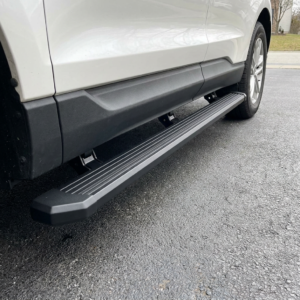
Ford SUV running boards to compare
The available examples are for Edge and Expedition applications, not the Explorer. They are shown only to compare Ford SUV formats and are not fitment claims.
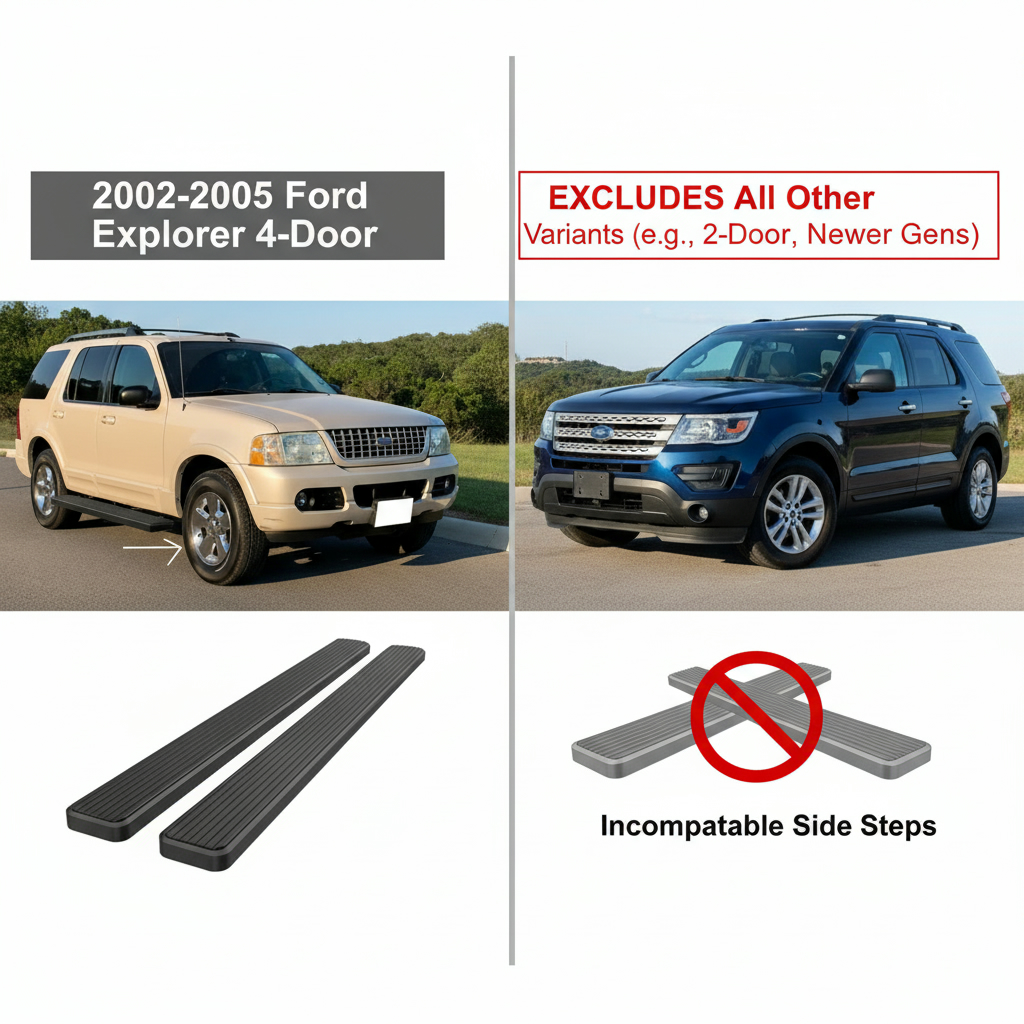
Many fitment statements are built from broad year ranges, trim exclusions, or body-style notes that are easy to miss. A single example of how narrow fitment can be: some listings specify a limited year span and door count for an Explorer application, such as a “TAC Side Steps” listing that calls out 2002–2005 four-door fitment and excludes other variants.
A more reliable mental model is this: if the listing language needs multiple exclusions, it is already signaling that small configuration differences matter. That same logic tends to apply even more strongly across a jump from 2002 to 2009.
Why The 2002 Explorer To 2009 Explorer Running Board Question Is Rarely A Simple Yes
The question “will 2002 Ford Explorer running boards fit 2009 Explorer” sounds like it should be answered by two model years and a bolt pattern. In practice, it is usually decided by a stack of small mismatches: how the body sits on the frame, where the manufacturer placed reinforced mounting points, and how much the running board design assumes a specific rocker-panel shape.
Even when both vehicles are called “Explorer,” the 2002 and 2009 generations are separated by major platform and body changes. That matters because running boards are not universal add-ons; they are load-bearing steps that transfer weight into specific structural locations. If those locations move by even a few centimeters, the board may bolt up in a way that looks aligned but loads the wrong area—something that can show up later as loosened fasteners, squeaks, or deformation.
Mounting Architecture: Where Fitment Usually Breaks
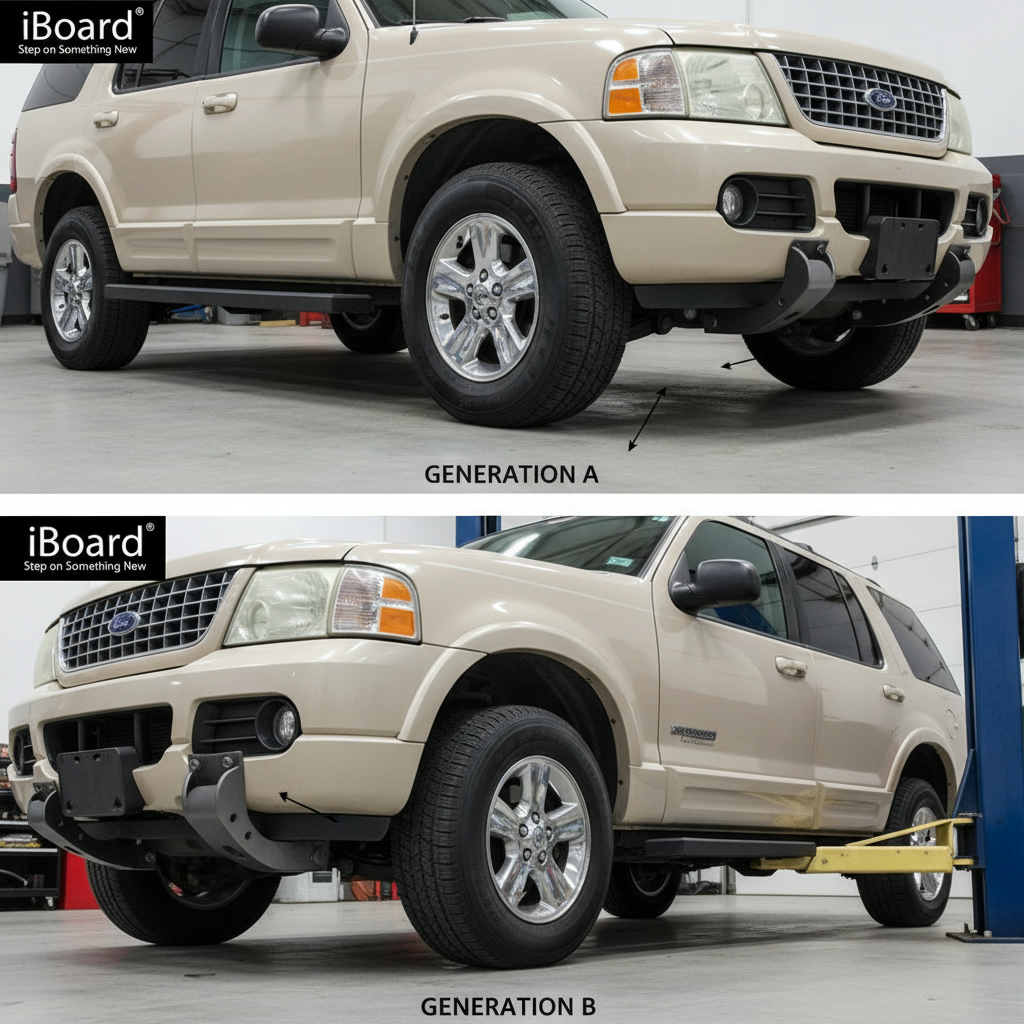
Most real-world fitment failures come from the mounting system, not the board itself. A running board kit typically expects a specific combination of factory holes, threaded inserts, or weld-nuts, plus brackets shaped to clear exhaust routing and suspension components. A generational change can alter all of that while keeping the door count and overall silhouette broadly familiar.
Key variables that tend to decide whether a 2002-style board can physically mount on a 2009 Explorer include:
- Attachment Points: some model years have factory-provisioned threaded points; others rely on different hole spacing or different reinforcement strategy behind the rocker.
- Bracket Geometry: a bracket designed for one frame rail profile may sit too high, too low, or interfere with underbody shielding on a later design.
- Load Path: even if holes line up, the structural backing may not, which changes how weight is distributed when someone steps on the outer edge.
- Clearance Envelope: exhaust layout, fuel and brake line routing, and splash shields can shift between generations, creating contact points that are not obvious during a quick test-fit.
Body And Rocker-Panel Differences: The Subtle Misalignment Problem
Fitment is also about how the board sits relative to the doors. If the rocker-panel contour and door-sill height differ between 2002 and 2009, the step can end up too tucked (hard to use) or too proud (more likely to catch debris or clip curbs). This is where the same “will 2002 Ford Explorer running boards fit 2009 Explorer” question splits into two separate realities: “can it be attached?” versus “does it sit correctly and safely?”
Small offsets matter because running boards are used dynamically. People do not step straight down; they often step outward, twist, and shift weight. A board that sits a little too far outboard increases leverage on the brackets. One that sits too close can reduce usable footing, especially in winter footwear.
Trim And Body-Style Traps That Mimic A Generation Issue
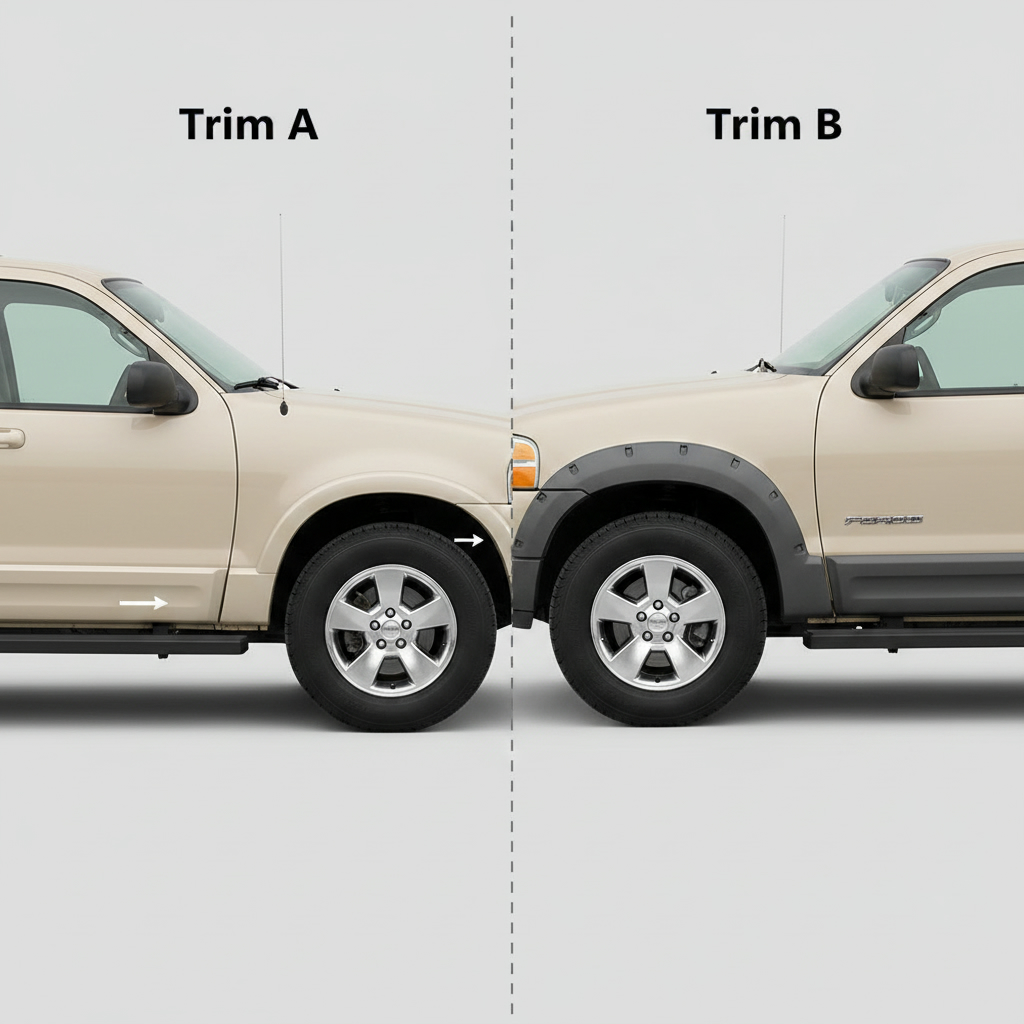
Some incompatibilities that get attributed to “2002 vs 2009” are actually trim and body-style conflicts. Door count, wheelbase length, and factory cladding packages can change the usable space along the rocker. A board that clears one lower-body molding may collide with another, and that can be misread as a fundamental platform mismatch.
For that reason, forum answers to “will 2002 Ford Explorer running boards fit 2009 Explorer” often contradict each other: different contributors may be talking about different sub-configurations without realizing it.
What Counts As Evidence In Fitment Claims
Fitment claims are most credible when they reference the underlying constraints rather than just a successful bolt-up. In the United States, guidance around vehicle modifications and safety equipment is often framed at an institutional level by agencies such as the National Highway Traffic Safety Administration (NHTSA) at https://www.nhtsa.gov/; while it does not certify aftermarket fitment, it is a useful anchor for understanding why load-bearing add-ons should be treated as safety-relevant modifications rather than cosmetic parts.
Also, the broader logic of why model-year changes can invalidate parts interchange is consistent with how manufacturers document service and parts compatibility; educational overviews of vehicle systems and design changes are commonly hosted by engineering programs such as MIT OpenCourseWare at https://ocw.mit.edu/.
As a single illustration of how narrowly many kits define compatibility, a listing like “TAC Side Steps Fit 2002-2005 Ford Explorer (4 Door)” signals that even within the Explorer nameplate, fitment is often bounded to specific years and body configurations.
Will 2002 Ford Explorer Running Boards Fit 2009 Explorer: Where The Yes/No Usually Comes From
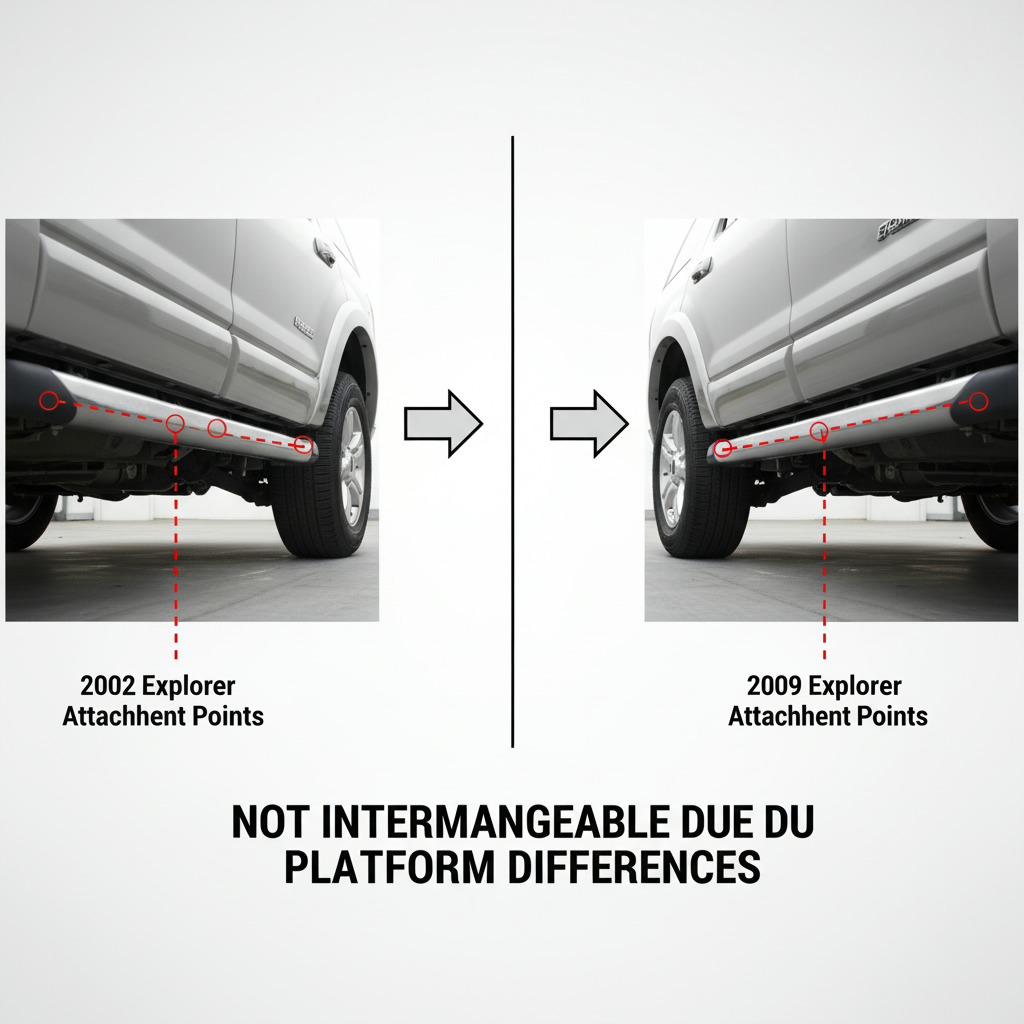
The question “will 2002 Ford Explorer running boards fit 2009 Explorer” is rarely answered by a single measurement, because the mounting strategy tends to be tied to the vehicle generation rather than the nameplate. Even when two vehicles share a similar silhouette, the underbody attachment points, bracket spacing, and the way the rocker area is reinforced can change substantially between model years. That is why many fitment resources treat the 2002 Explorer and the 2009 Explorer as different “platform problems,” not a simple swap.
In practice, a confident answer usually depends on whether the 2009 body has factory provisions in the same locations and with the same thread type and load path assumptions as the 2002 design. If the later vehicle relies on different attachment points or different reinforcement, forcing compatibility can shift loads into thin sheet metal, which is where long-term loosening, deformation, or corrosion risk tends to show up.
Compatibility Isn’t Just Length: What Actually Breaks Interchangeability
When people ask whether 2002 parts fit a 2009 vehicle, they often picture “same wheelbase, same door count, same length.” That can be misleading. Interchangeability is usually broken by small, unglamorous differences underneath.
- Attachment Architecture: some vehicles use pre-threaded inserts or welded nuts in specific locations; others rely on different brackets or different reinforced zones. A mismatch here is more important than overall length.
- Bracket Geometry: even if holes exist, the standoff distance and bracket angles can change, affecting door clearance and the way loads transfer into the body structure.
- Corrosion and Sealing Details: later designs may manage water and salt differently around the rocker area; adding hardware in unintended places can compromise protective coatings.
- Trim and Clearance Constraints: changes in cladding, pinch weld shape, or jacking-point location can create interference that is not obvious until test-fitting.
For a grounded check, the most credible sources are typically the manufacturer’s service information and parts catalog logic, not forum consensus alone. Ford’s owner and service literature entry points are publicly accessible through Motorcraft (https://www.motorcraft.com/) and can help confirm whether the 2009 body is designed with specific mounting provisions.
What “Fitment Charts” Usually Mean And Why They Conflict
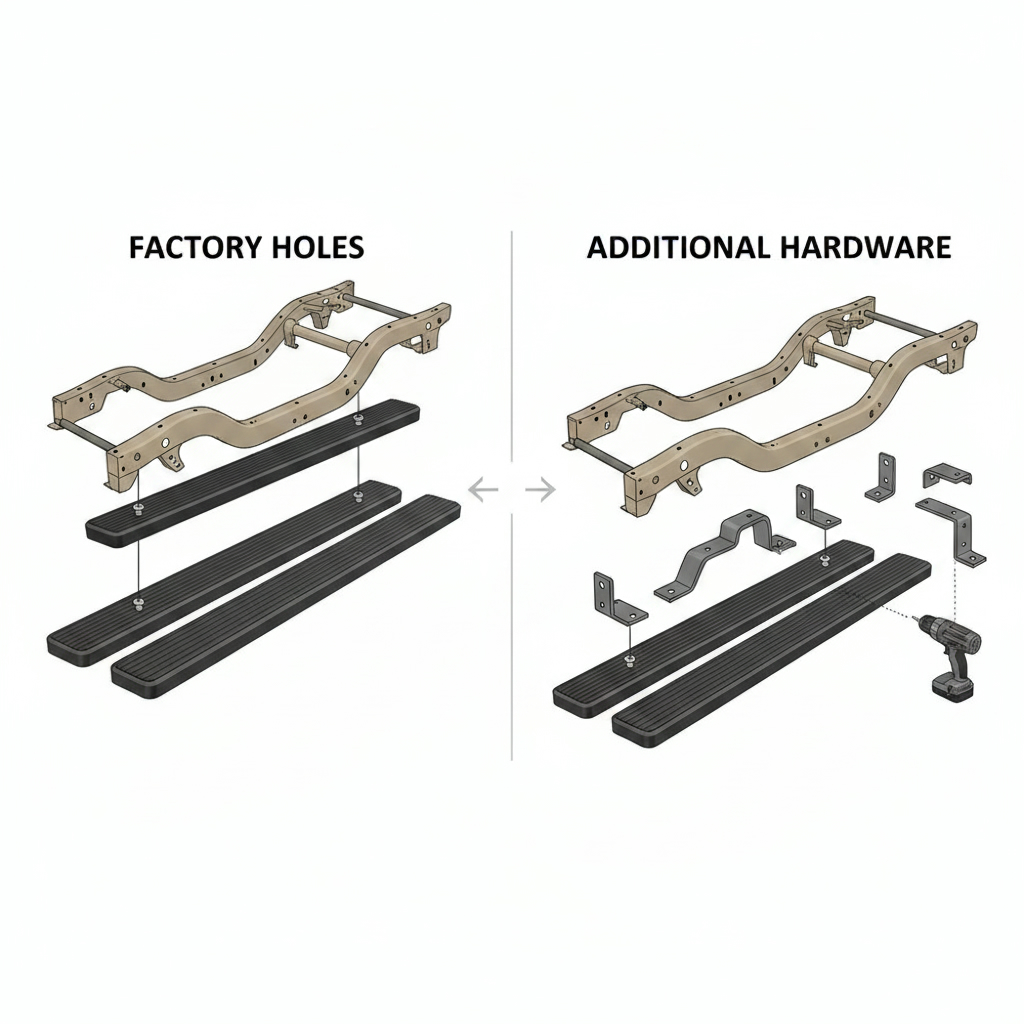
Fitment charts often compress complex engineering decisions into a year range, and different publishers use different rules. Some charts mean “bolts on with factory holes.” Others mean “can be made to work with additional hardware.” Those are not the same claim, even if they look similar in a search snippet.
When the query is framed as “will 2002 Ford Explorer running boards fit 2009 Explorer,” the most useful way to read any chart is to look for the assumption behind the word “fit”:
- Does it assume existing attachment points with no drilling?
- Does it assume a specific body style that quietly changed between years?
- Does it define exclusions in fine print (trim packages, submodels, or running changes)?
For safety and durability context, it can also help to understand why improvised attachments are treated cautiously in the automotive world: components attached to the vehicle body can influence how loads are introduced during entry/exit and minor impacts. NHTSA’s consumer-facing resources and defect framework provide useful background on why secure attachment and correct hardware matter in general (https://www.nhtsa.gov/).
Practical Clarifications That Reduce Guesswork Without Turning Into A How-To
Some doubts repeat because they sound logical but point in the wrong direction. A few clarifications tend to settle the confusion.
- The name “Explorer” does not guarantee shared underbody hard points across generations; generational changes are the default, not the exception.
- Door count alone is not a reliable proxy. Two four-door vehicles can still have different rocker reinforcements and bracket spacing.
- “Close enough” alignment can still be structurally wrong if it changes where forces enter the body.
In other words, the question “will 2002 Ford Explorer running boards fit 2009 Explorer” is really a question about shared mounting provisions and load paths, not about aesthetics or approximate length.
FAQ: Interpreting “Will 2002 Ford Explorer Running Boards Fit 2009 Explorer” In Real Searches
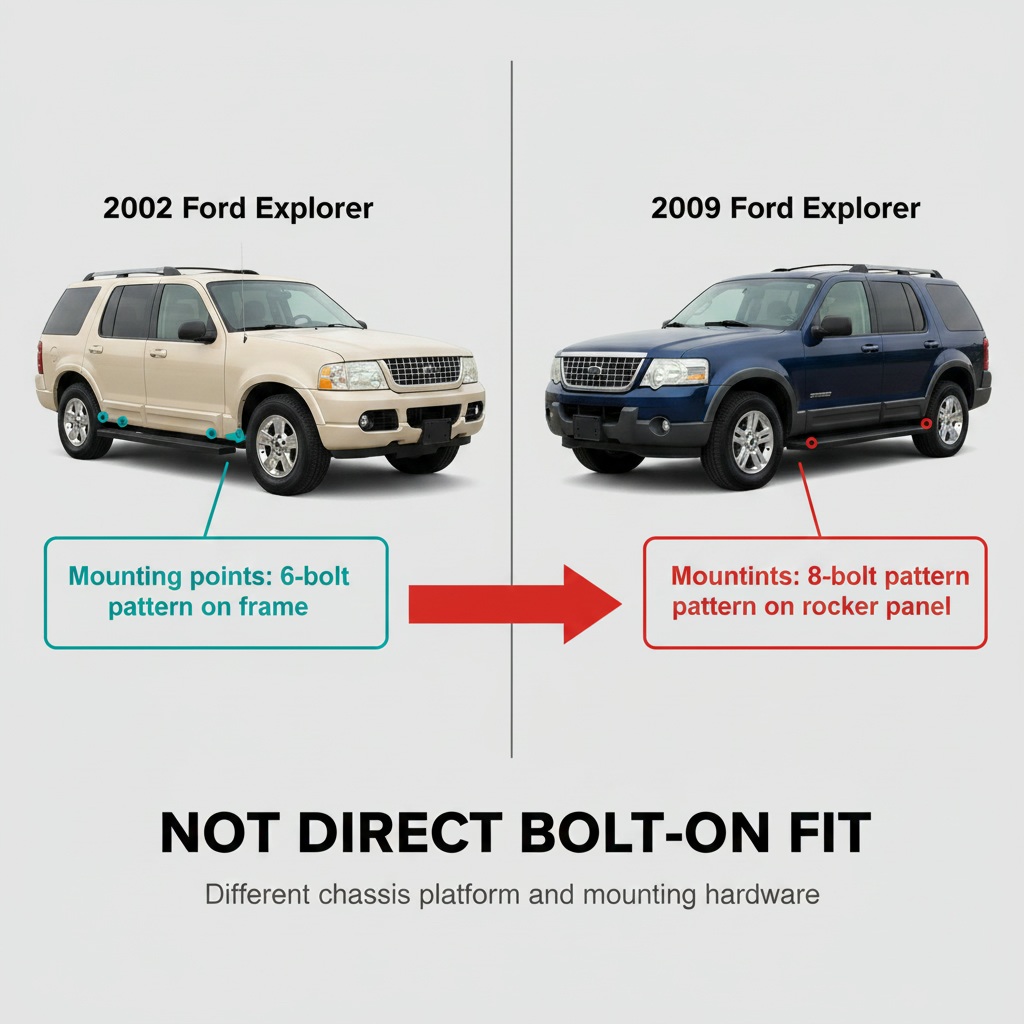
Why Do Answers to “Will 2002 Ford Explorer Running Boards Fit 2009 Explorer” Vary So Much?
Because “fit” is used to mean different things: direct bolt-on, partial alignment with modifications, or simply similar overall dimensions. Sources also differ in whether they track platform changes and mid-year updates.
If The Attachment Points Seem Similar Underneath, Does That Mean It’s Compatible?
Not necessarily. Similar-looking holes or seams do not confirm thread type, reinforcement, or the intended load-bearing design. Compatibility depends on whether the later body structure is designed to take that kind of repeated side load in those exact locations.
Why Do Some Resources Exclude Certain Submodels or Trims Even Within the Same Year Range?
Because underbody packaging can change with trim-related cladding, different rocker designs, or factory equipment that occupies the same space. Exclusions often signal a clearance or mounting-provision difference rather than a cosmetic issue.
Is Drilling New Holes Into the Body Treated as a Minor Detail or a Meaningful Change?
It is a meaningful change because it can bypass factory reinforcements and compromise corrosion protection if not engineered and sealed correctly. Even when it “works,” long-term durability can diverge from what the body structure was designed to support.