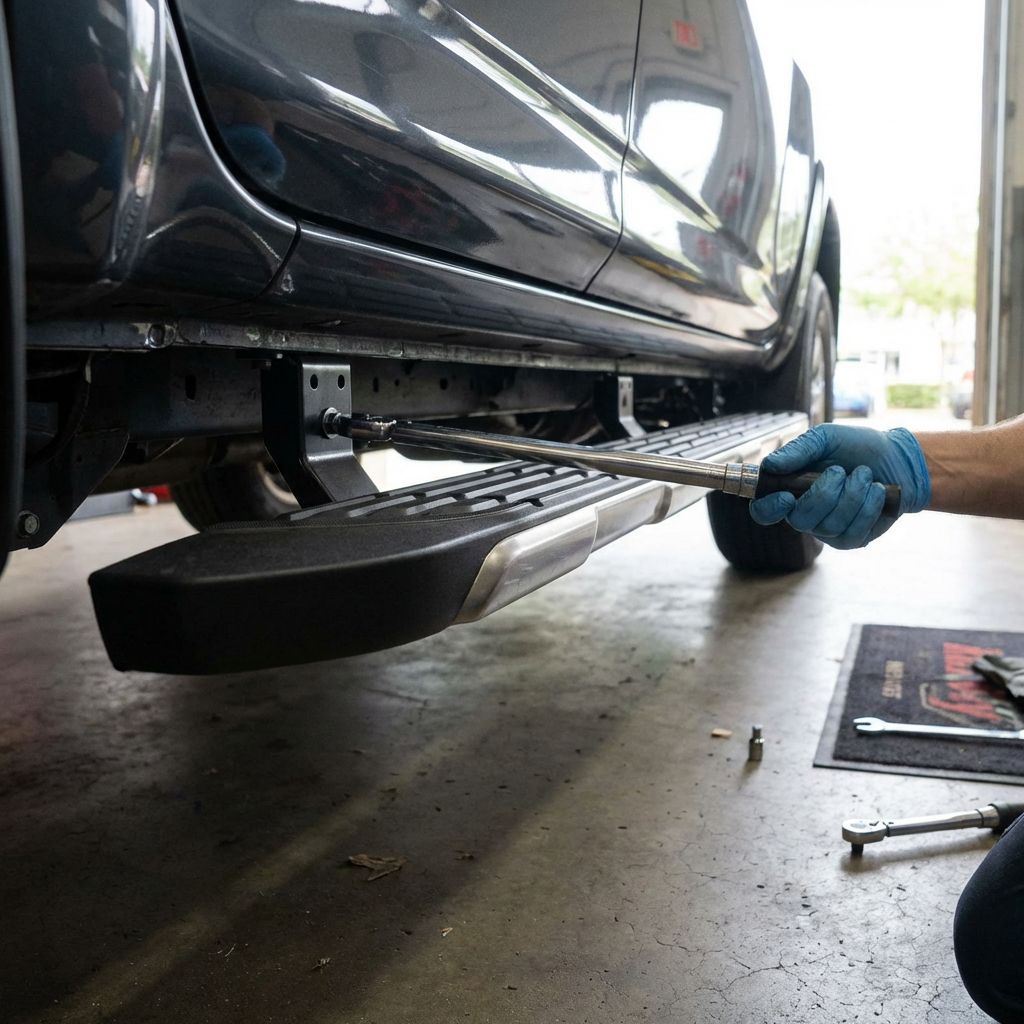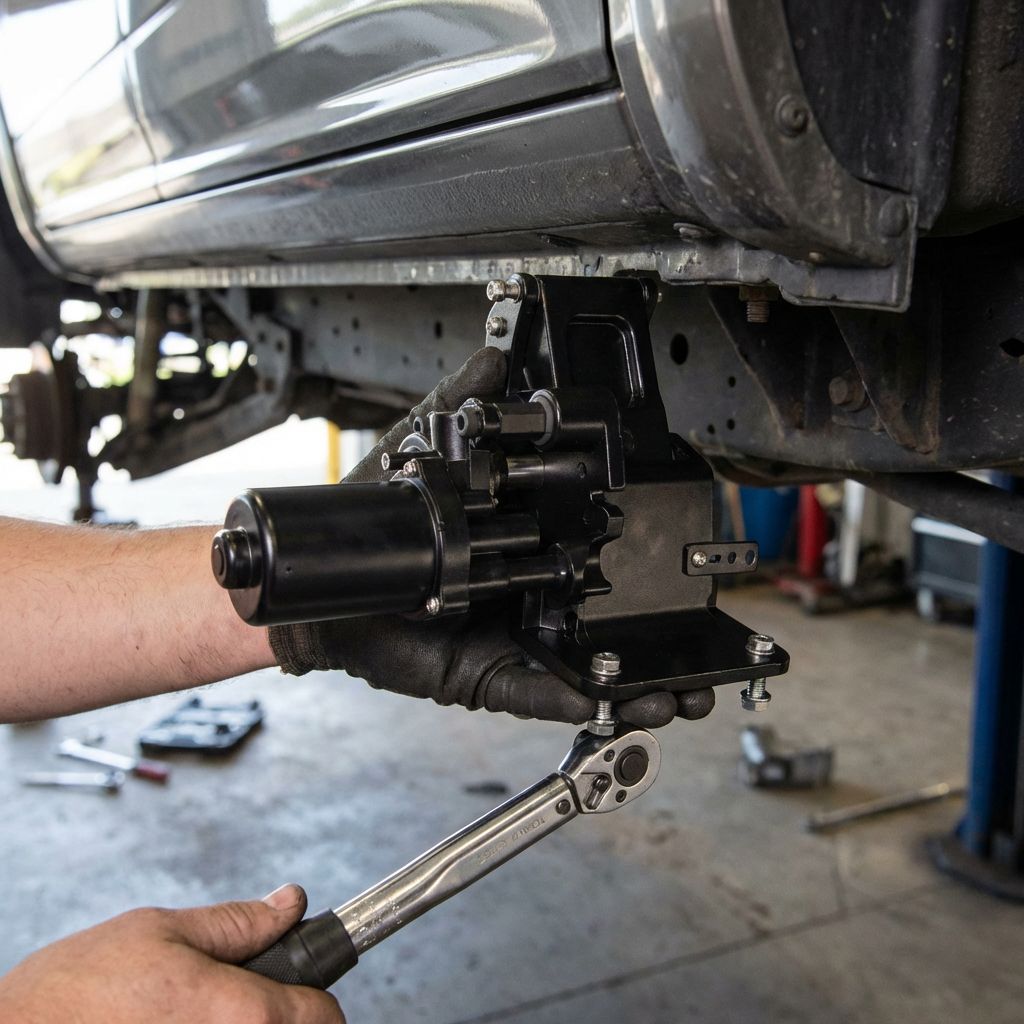
For a 2020–2026 Jeep Gladiator JT, power running boards make sense for easier entry, but they add wiring complexity and can affect ground clearance.
When Jeep Gladiator power running boards are a sensible choice
They make sense for drivers who get in and out often, carry kids, or use the Gladiator as a daily with larger tires or a lift that makes the step up awkward. The real benefit isn’t “looking cool.” It’s reducing strain on knees and hips, and giving a more predictable step when the ground isn’t level.
But they aren’t a “no-compromises” solution. A motorized system adds components that need protection: wiring, control module, linkages, motors, and sensors. In mud or road salt, a fixed step often tolerates abuse better.
For a JT 4-door (2020–2026), set expectations like this: a retracting or folding step can improve access, but it can reduce ground clearance when deployed and may need more regular upkeep than a traditional side step.
- Best if your use is urban or mixed and access matters more than rock protection.
- Less appealing if you wheel often with rocks, deep ruts, and frequent side contact.
- In harsh winters with road salt, plan on protection and periodic cleaning of pivots.
BINARY STAR Running Boards: quick context on the reviewed product
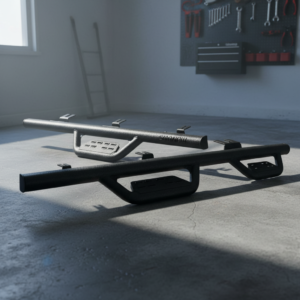
Many searches start with “Jeep Gladiator power running boards,” but not everything that shows up is a true retractable, motorized step. The BINARY STAR Running Boards for Jeep Gladiator JT 2020–2026 sit in the traditional fixed running-board category, with carbon-steel construction and a stated 6-inch-wide stepping surface. That distinction changes expectations.
A wide fixed board helps day-to-day access with less electrical complexity. In exchange, it stays exposed all the time and can become the first contact point on speed bumps or off-road obstacles. It’s a more “mechanical” choice than an “automatic” one.
In the context of researching aftermarket power running boards, this option is relevant as an alternative for anyone who wants a stable step and doesn’t want to deal with wiring, modules, and sensors. It is not the right answer if you want the automatic deploy/retract effect.
To verify details, variants, and what’s in the box, see the product page here: BINARY STAR Running Boards.
A second model aimed at a similar use case, but with a different approach, is the BINARY STAR Curve Design Running Boards. It leans more into a “drop-down” geometry that can lower the step, directly affecting entry comfort and ground clearance. To compare that approach: BINARY STAR Curve Design Running Boards.
What really separates a motorized running board from a fixed one
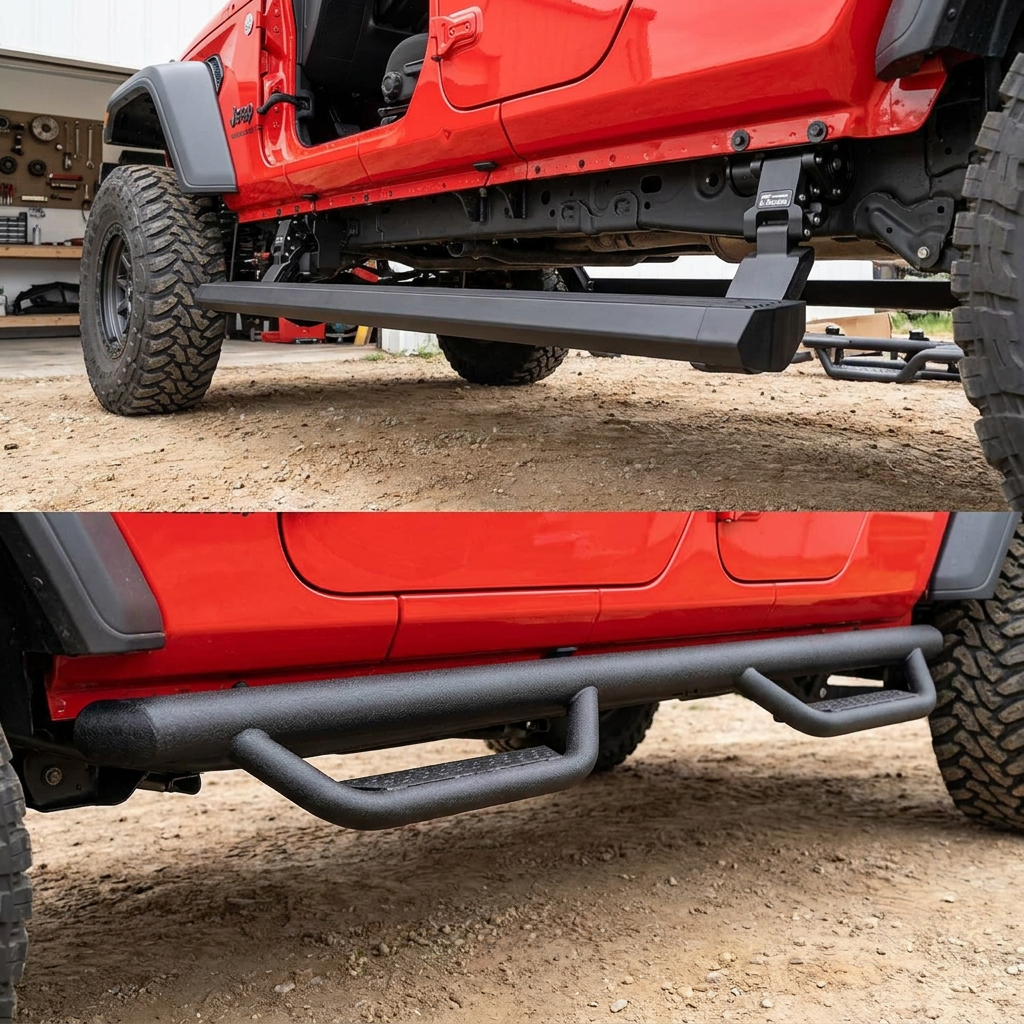
Jeep running boards to compare
The available catalog options are for Wrangler JL and JK/JKU, not confirmed Gladiator applications. They are shown only for format comparison.
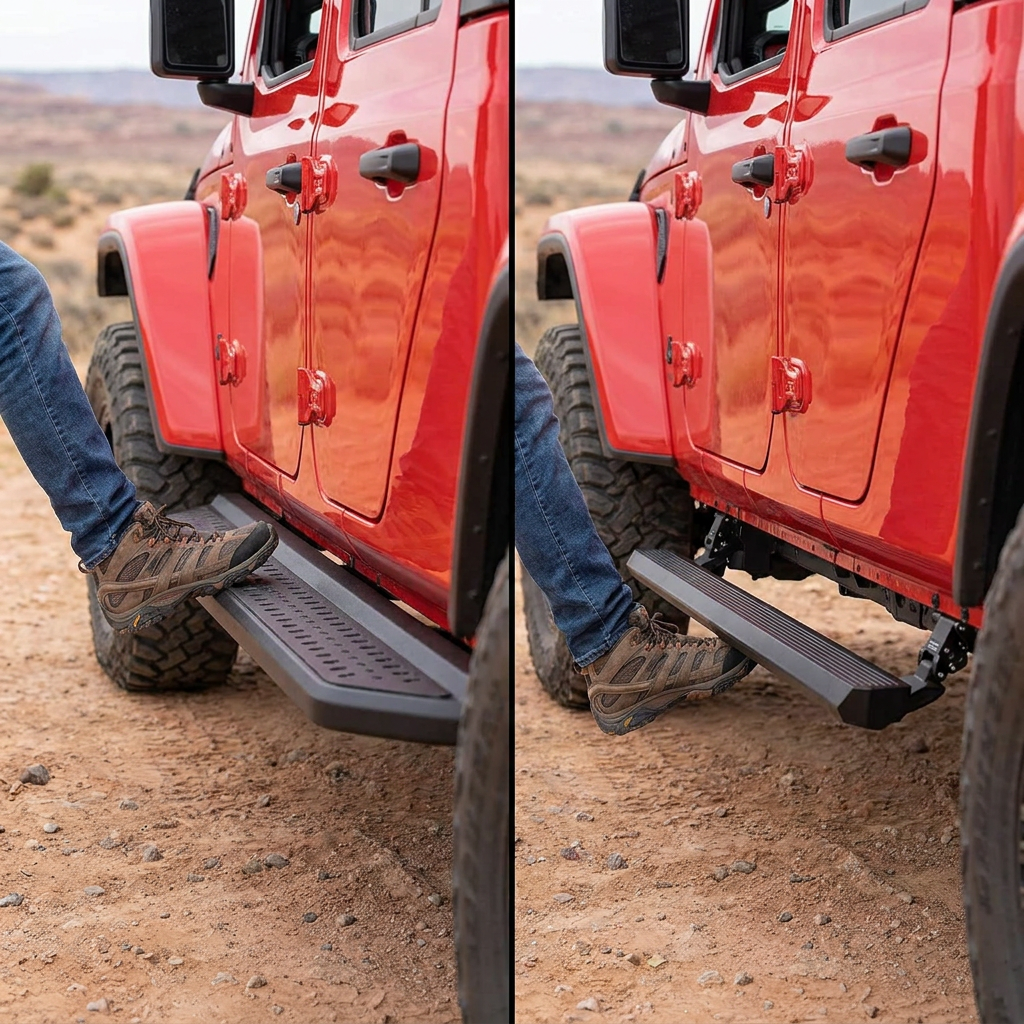
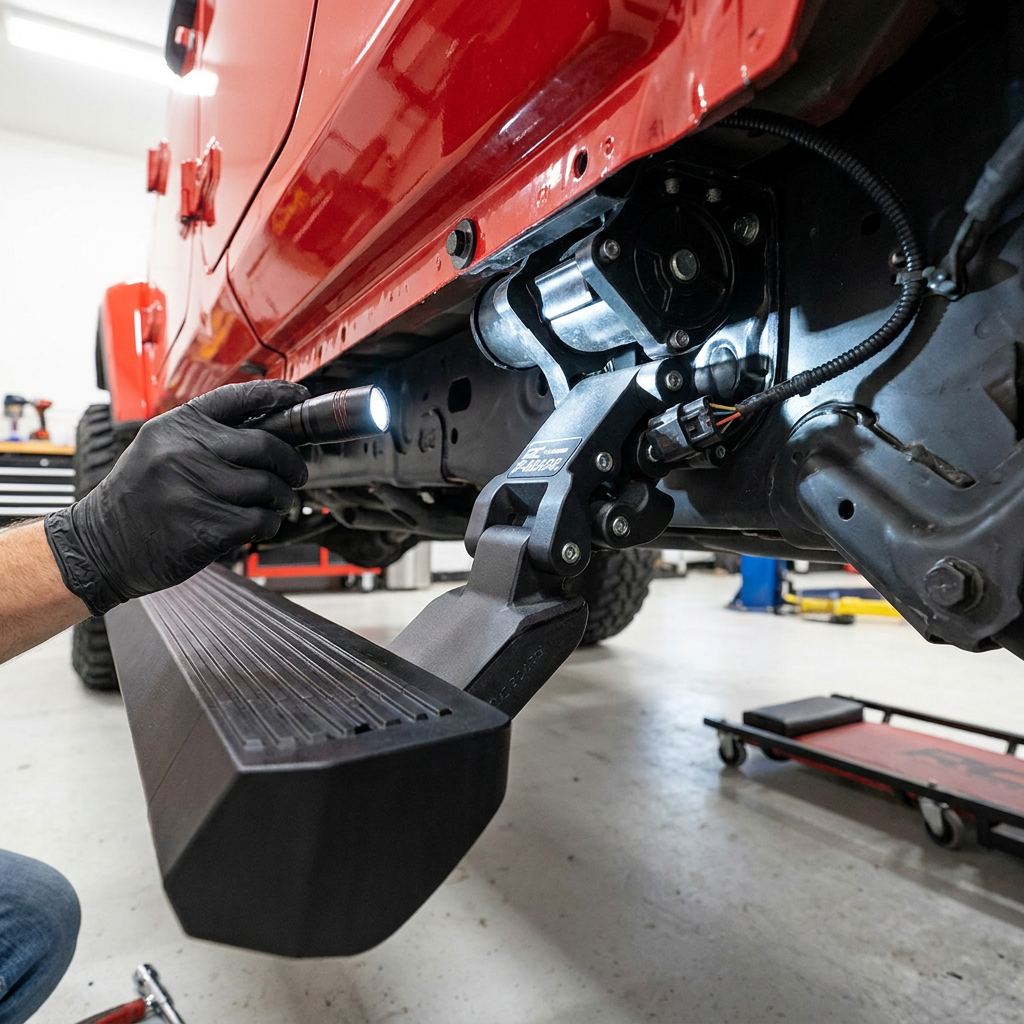
A true power running board has a specific goal: stay tucked close to the body and drop down only when needed. To do that, it uses an actuator assembly (motor or motors), articulated arms, a control module, and a trigger signal tied to the doors or vehicle network. On a Jeep Gladiator JT, electrical integration quality matters as much as the board’s strength.
A fixed board like the BINARY STAR works the opposite way. It always sits at the same height and sticks out the same amount. It’s more predictable when stepping up in boots or when loading and unloading the bed, because there’s no deploy timing. But it never “disappears,” which affects two things: dirty aerodynamics from mud buildup and contact risk.
People shopping power folding running boards often underestimate one practical detail: a moving step must also stop safely. Better systems include obstacle detection and a disable mode or manual override. That’s not a bonus feature—it’s the difference between an inconvenience and damage when ice, gravel, or a jack ends up in the wrong place.
At the same time, anyone buying a fixed board has to think about a different limit: the step position can reduce ground clearance all the time. If the Gladiator is already low or used on trails with crests, a wide board can become a “hang-up point.”
Fitment on the 2020–2026 Gladiator JT: checks that prevent returns and surprises
Stated compatibility like “2020–2026 Jeep Gladiator JT 4 Door” is a good start, not the finish line. The JT has variations in suspension, tires, and accessories that change usable space around the rocker area. Before choosing between Jeep Gladiator power running boards and fixed steps, it’s worth doing a few quick, concrete checks.
First: side geometry. A 6-inch step can be comfortable, but you need to consider how far it protrudes relative to the body line. On a JT with wider tires, a board that tucks in tight gets dirtier; one that sticks out more can catch rocks and branches.
Second: true step height. A “drop down” design lowers the step, and for many people that’s the real reason to buy. But it can reduce ground clearance at the most vulnerable point. On ramps and breakovers, you’ll notice it immediately.
Third: accessory interference. Mud flaps, skid plates, rock rails, and some bracket styles can conflict with mounting points. In a clean install, holes and brackets should align without forcing. If you have to “pull” a bracket into place, corrosion and loosening tend to show up sooner.
- Confirm it’s for a JT 4-door and not a Wrangler JL “because it looks similar.”
- Match it to real use: city, snow, mud, or off-road with frequent side contact.
- Estimate ground-clearance loss at the lowest point of the step/brackets.
One last context note: people coming from searches like f250 power running boards oem or how to reset power running boards gmc often expect factory-style logic. With aftermarket kits, long-term satisfaction depends heavily on wiring quality, connector sealing, and control-module placement. It’s not obvious in photos, but it can decide how things go after one winter.
Wide fixed board vs “drop-down” board: where the experience really changes
Many people searching Jeep Gladiator power running boards are really chasing a “lower step,” not just a side platform. With that need, the practical difference between the BINARY STAR Running Boards (straight board with a stated 6-inch platform) and the BINARY STAR Curve Design Running Boards (drop-down style) isn’t cosmetic—it’s entry geometry.
A wide, relatively higher platform tends to suit people who step up from the side and want a broad, stable surface. It also works well with boots or aggressive tread. A drop-down option lowers the first step and makes it easier to get in without pulling on the steering wheel, but it often puts the lowest bracket point closer to speed bumps and ledges.
For some drivers, the lower step matters more than ground clearance. For others, it’s the opposite—and it’s not a decision you can make from photos alone.
| Use scenario on the Gladiator JT | More consistent BINARY STAR option | Practical reason |
|---|---|---|
| Daily use, frequent entry/exit, varied footwear | BINARY STAR Running Boards (wide platform) | Wide, predictable surface; less need to “aim” your foot |
| Hard entry due to height, shorter passengers, kids | BINARY STAR Curve Design Running Boards | Lower step; reduces effort on the first move |
| Steep ramps, speed bumps, off-road breakovers | BINARY STAR Running Boards (higher, straighter profile) | Often less exposed at the lowest point than a pronounced drop |
| Mud and snow buildup | BINARY STAR Running Boards (open, wide platform) | Easier to “clear” with your foot; fewer collection points near the drop |
One often-missed detail: a drop-down board can feel more comfortable stepping up, but when stepping down it can increase the chance of catching your heel on the outer edge if your body rotates. Anyone who uses the bed often and steps down backward notices this quickly.
In practice, the Curve Design brings part of what people want from power folding running boards—easier access—using a fixed solution. No automatic deploy. No retract.
Materials, finishes, and corrosion: what to check before the first winter
A fixed carbon-steel board lives or dies by its surface protection. “Painted” isn’t enough. What matters is where the finish gets interrupted: edges, holes, weld zones, and clamp points where brackets can mark the coating during installation.
On a Jeep Gladiator JT used in road-salt areas, two spots are most vulnerable. First: the joint between brackets and the board, where moisture can get trapped. Second: the inner face, which gets washed less and sees more spray. A 6-inch-wide board helps access, but it also provides more surface for brine to sit on.
A useful pre-install check is a simple bench inspection: look at edges for coating continuity, check holes for bare metal vs protection, and decide in advance how you’ll protect clamp/torque areas.
- If the kit includes zinc-plated hardware, it’s fine to start, but in harsh areas it can be worth upgrading to stainless or adding anti-corrosion treatment on threads.
- A light waxy/rust-inhibiting coating on hidden surfaces reduces trapped-moisture corrosion without making the stepping surface slippery.
- Washing the rocker area after snowstorms isn’t a luxury—it’s maintenance.
When safety is the concern, there isn’t a single “running board standard” to point to. It’s basic fastener practice. Correct torque—using the kit maker’s or vehicle maker’s specs—helps prevent loosening that can turn into elongated holes and vibration. For general background on automotive fasteners and strength classes, a useful technical reference is SAE J429: SAE J429.
You don’t need perfection. You need to avoid predictable mistakes—especially if the original goal was to avoid the complexity of motorized aftermarket power running boards and their electrical components.
Real-world installation on the JT: time, pain points, and build quality
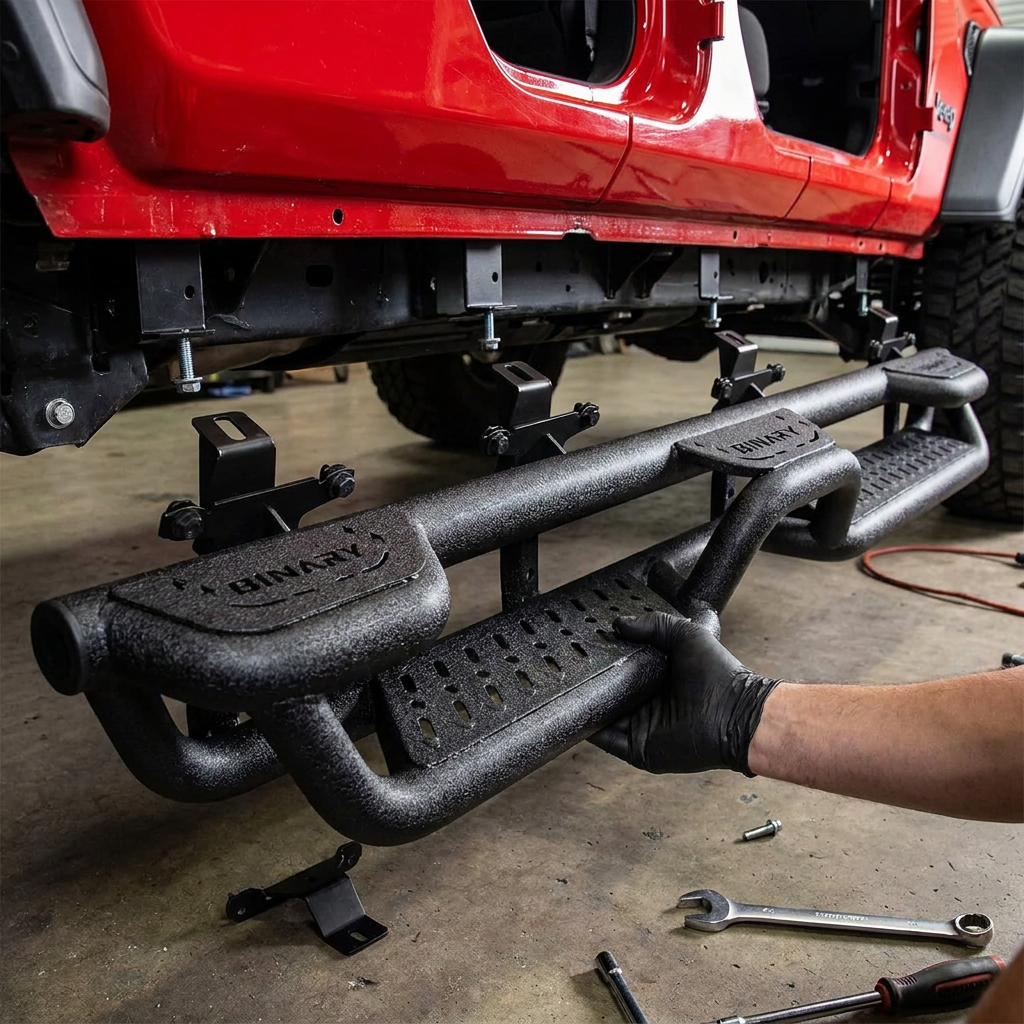
With a fixed board, the variable that decides satisfaction isn’t “will it mount,” but how it mounts. On a 2020–2026 Gladiator JT, a clean install typically lands in a realistic 1–3 hour window, depending on existing rust, other accessories, and your familiarity with rocker-area hardware.
The first critical point is alignment. A board that’s even a few millimeters out of square shows with the door open and feels odd when stepping up, because your foot always looks for the same reference. The second point is repeatability: left and right should land at the same perceived height. That’s not just visual symmetry—it’s muscle memory.
A third point is unwanted contact. If the board rubs mud flaps, armor, or other accessory brackets, vibration over time becomes noise and then finish wear. On rough roads, it doesn’t take much.
- Before final torque, simulate use: open/close doors, step up with one foot, then two, and listen for any ticking.
- If a bolt spins or doesn’t bite cleanly, fix it immediately. Forcing it leads to damaged threads and fasteners that loosen.
- If you expect mud and frequent washes, consider sealing spots where water can sit between bracket and body.
Here’s a useful paradox for anyone searching Jeep Gladiator power running boards: a fixed board avoids wiring and modules, but it demands more mechanical care during installation. A motorized system may have a “guided” harness; a fixed board depends heavily on the person aligning and torquing it.
People coming from f250 power running boards oem or how to reset power running boards gmc often think in terms of electrical diagnosis. With these BINARY STAR boards, diagnosis is mechanical: play, torque, alignment, and corrosion protection.
Daily use and maintenance: what changes after 30 days
After about 30 days of use, two things become clear that feel abstract at purchase time. First is cleaning: a wide board collects mud and fine gravel, and very aggressive texture holds onto more. Second is step “memory”: once your foot learns a step, any small difference in height or protrusion between driver and passenger sides becomes obvious.
At this point, the difference between a straight board and a drop-down board becomes more concrete. The Curve Design tends to hold more grime in the lower area and may need more frequent rinsing if you want to avoid buildup near brackets. The straight board is usually easier to hose off, but it stays more exposed to side hits from rocks and curbs.
Reasonable maintenance isn’t complicated—it’s consistent.
- Re-check torque after the first week and again after a month, because initial settling can change how solid it feels.
- Winter rocker-area washing: not just looks, but reducing salt dwell time.
- Visual checks for deep scratches: if metal is exposed, quick touch-up helps prevent rust spreading under the coating.
For anyone originally leaning toward rc power running boards or other motorized options, this is the real trade: less electronics, more mechanical discipline. That’s not a flaw—it’s a different way of owning the accessory.
Warranty, support, and longevity: what matters after purchase
In the Jeep Gladiator power running boards world, the difference between “happy” and “annoyed” often doesn’t show up on day one. It shows up when you need a replacement part, a bracket, or clarification on installation. For a fixed board, the support chain matters less than for a motorized system, but it still matters.
Before choosing between the two BINARY STAR options, check three practical items: warranty terms (length and coverage), availability of replacement hardware/brackets, and a support channel that responds in normal time. If communication is confusing before purchase, solving a problem later tends to take longer.
Another factor that drives longevity is real use. A Gladiator that lives in the city and rarely sees side impacts wears its finish slowly. A JT that regularly brushes rocks, ruts, or branches stresses edges and clamp points. In that context, the board doesn’t “fail” by magic—it gets gouged, exposes metal, and corrosion starts there.
For people coming from searches like f250 power running boards oem or questions like how to reset power running boards gmc, expecting dealership-style support isn’t realistic for many aftermarket kits. A simpler approach works better: pick a kit with clear instructions, install it carefully, and plan periodic checks.
Where these sit compared with true motorized running boards
The phrase “aftermarket power running boards” often points to retractable systems with motors, sensors, and a control module. Yet for many Gladiator owners, the real need is a comfortable, stable step—not automation. For that need, the BINARY STAR Running Boards can be closer to the right answer than the “Jeep Gladiator power running boards” search term suggests.
This needs a clear stance. If you want a step that deploys and retracts, these aren’t the right choice. Period. They’re a mechanical alternative for anyone who wants to avoid wiring and potential electrical troubleshooting—and for some users, that’s a bigger advantage than the “power folding” effect.
The Curve Design model tries to replicate part of the benefit people want from power folding running boards: easier entry via a lower step. But it’s still fixed, with constant exposure to impacts and grime. So the right comparison isn’t “better or worse than motorized.” It’s “how much is automation worth versus simplicity,” on your JT and in your climate.
When the priority is reducing complications, the most sensible choice is usually the one with fewer variables. Here, a well-installed fixed board offers predictability that many budget electric systems don’t maintain over time—especially with mud, ice, and salt.
When it works well—and when it becomes a compromise
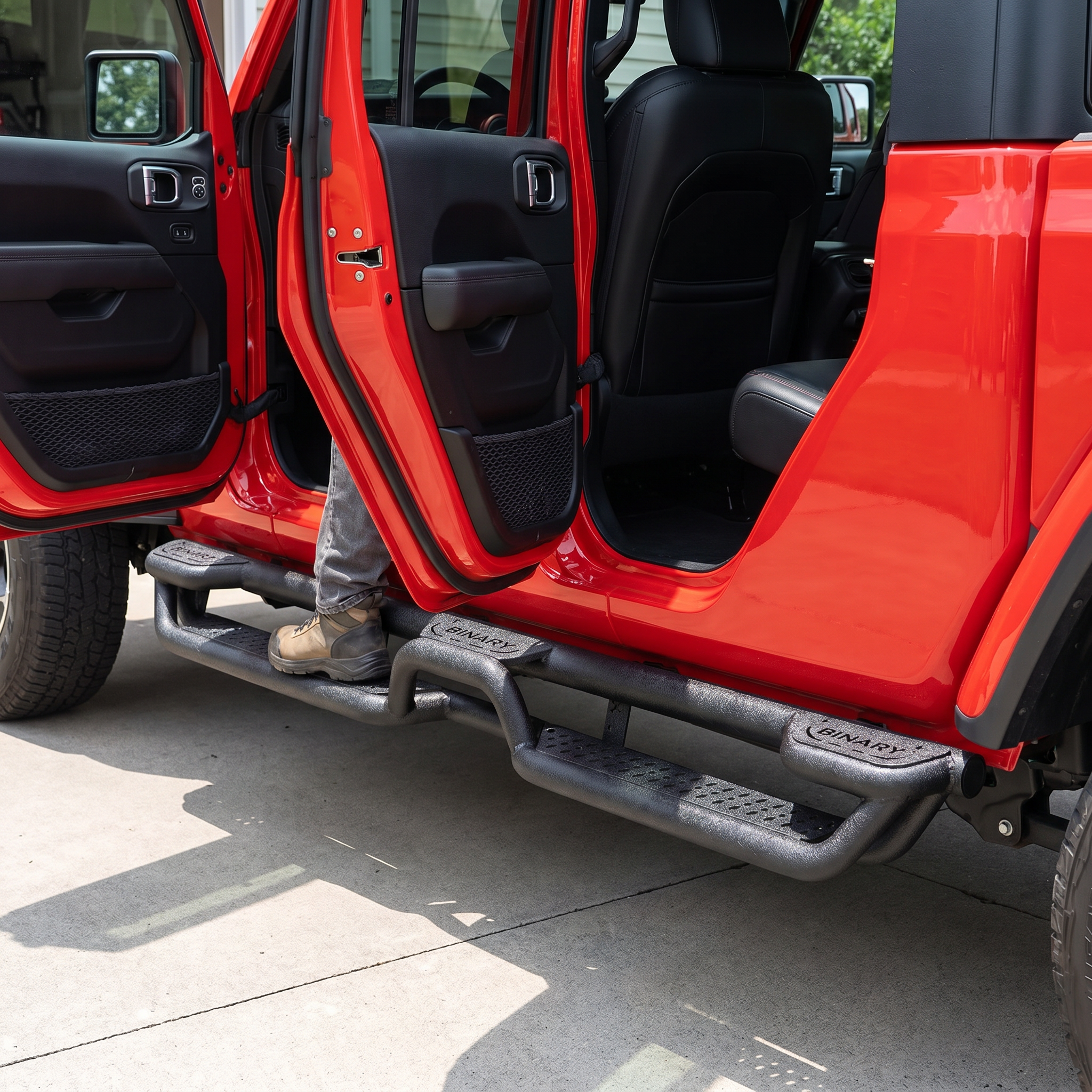
It works well on a Jeep Gladiator JT used as a daily driver or mixed-use truck, with frequent entry/exit and passengers who appreciate a stable step. It also makes sense when the goal is to avoid the complexity typical of true Jeep Gladiator power running boards, without giving up a wide, always-ready platform.
It becomes a compromise for anyone who truly wants the retracting “tucked away” effect of power running boards, or for frequent off-road use with regular side contact where rock-rail-style protection matters more than a step. In those cases, a fixed board stays exposed and may conflict with how the truck is used, even if entry is easier.
Frequently asked questions
Are “Jeep Gladiator power running boards” and these BINARY STAR the same thing?
No. True power running boards are motorized and move with the doors or vehicle network. The BINARY STAR options are fixed boards: they improve access, but they don’t deploy or retract.
Does it make sense to consider them if I searched for “power folding running boards”?
Only if your real goal is an easier step, not automation. The Curve Design, with a lower step, can feel closer to that entry experience—but it stays exposed all the time.
What should I expect in snow and road salt with non-motorized aftermarket power running boards?
Expect mechanical maintenance, not electrical troubleshooting. The main risk is corrosion starting at scratches and clamp/torque points. Rocker-area washing and visual checks matter more than any slogan.
Why do searches like “how to reset power running boards gmc” show up in the same topic area?
Many motorized running-board searches end up focused on modules, sensors, or synchronization issues. With a fixed board there is no “reset”—the checks are torque, alignment, and coating condition.
Between the flat board and the Curve Design, which is the safer choice for a JT with frequent ramps and speed bumps?
In general, the straighter board tends to create fewer low, protruding points. The Curve Design can be more comfortable stepping up, but it can cost ground clearance at the most vulnerable spot. The right decision depends on where your JT actually contacts.
Verdict and use case
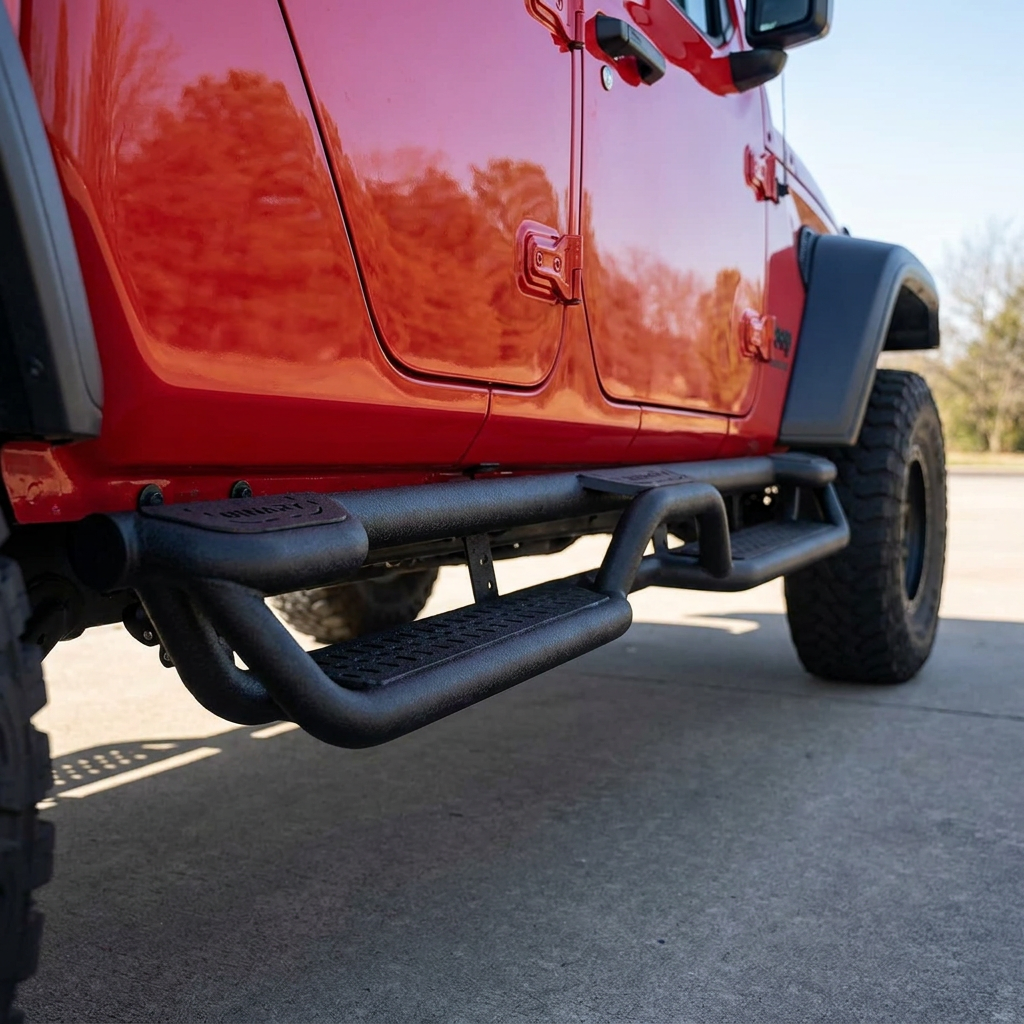
The BINARY STAR Running Boards are a sensible choice when the priority is a stable, simple step—not a true “power” solution. They should be read as a practical alternative within a Jeep Gladiator power running boards search, not as an equivalent.
The best-fit use case is a 2020–2026 Gladiator JT used every day, with frequent entry/exit and passengers who want a wide, immediate step—even with dirty shoes or uneven ground. In that context, mechanical simplicity matters more than automation.