
The question sounds simple, but “Dodge pickup” covers multiple truck lines, generational changes, and body configurations where a running board can look almost identical yet mount completely differently. Fitment is less about the badge on the grille and more about the geometry hidden underneath: cab length, rocker panel shape, and where the factory provides strong mounting points.
Most confusion comes from interchangeability assumptions—especially when trucks share a similar silhouette or when model years overlap with mid-cycle updates. Running boards sit in a narrow space between the cab and the ground, so small differences in frame brackets, pinch weld design, or cab-to-frame spacing can decide whether an install is straightforward or not viable without modification.
Quick Orientation For “Will Dodge Running Boards Fit Any Dodge Pickup”
- What it is in practical terms: a fitment question about whether a step assembly bolts to the truck’s existing attachment points without drilling or custom brackets.
- How people typically encounter it: while trying to reuse boards from another truck, match a set listed for a different year, or interpret “fits Ram/Dodge” labeling.
- Safe assumption: fitment is usually cab- and year-specific.
- Misleading assumption: “Dodge running boards” are universal across all Dodge pickups.
Why “Dodge Pickup” Fitment Is Not One Size Fits All
Historically, “Dodge pickup” is often used casually to refer to Ram trucks across years, including periods when branding and naming conventions shifted. That naming shorthand can blur important distinctions: a change in cab structure or mounting provision does not need to be dramatic to break compatibility.
Running boards transfer load into the vehicle structure. For that reason, reputable installations rely on reinforced points—often existing threaded holes, factory studs, or specific bracket locations designed to handle repeated step loads. When those points move even slightly between generations or trims, the board’s bracket spacing no longer matches.
The Fitment Variables That Actually Decide Compatibility
When asking whether Dodge running boards fit any Dodge pickup, the practical answer depends on a small set of physical variables that tend to matter more than model name alone.
- Cab configuration: regular, extended, and crew cabs have different rocker lengths and door spacing; boards must match that length and bracket layout.
- Model year and generation breaks: redesigns can change the underside even if the exterior looks familiar, shifting mounting points and clearances.
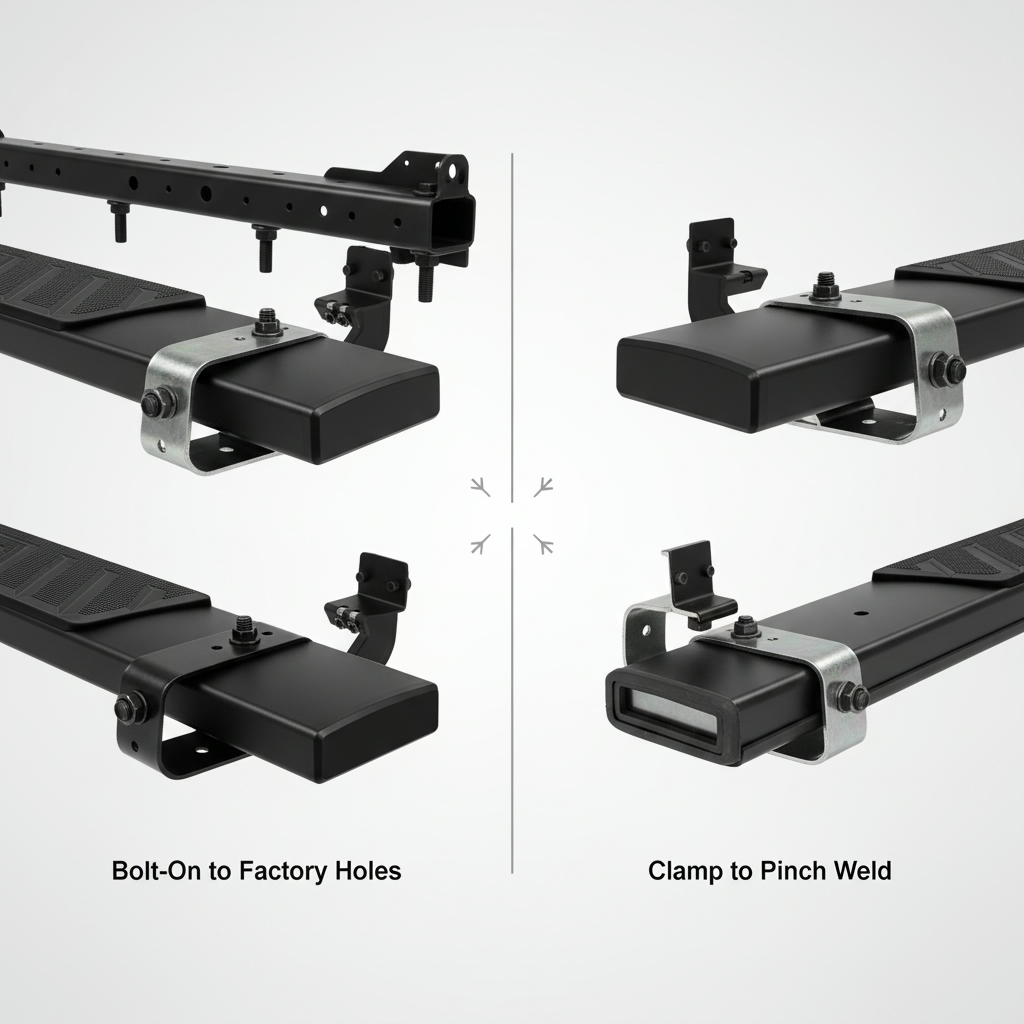
- Attachment style: some trucks support direct bolt-on brackets; others rely on pinch weld clamping or a mix of methods, each with its own constraints.
- Bed and wheelbase interplay: wheelbase does not directly set running board length, but it often correlates with cab/trim packages that change mounting provisions.
- Clearance and interference: mud flaps, splash guards, and factory aero shields can conflict with bracket shapes or step placement.
Where Interchangeability Assumptions Usually Break Down
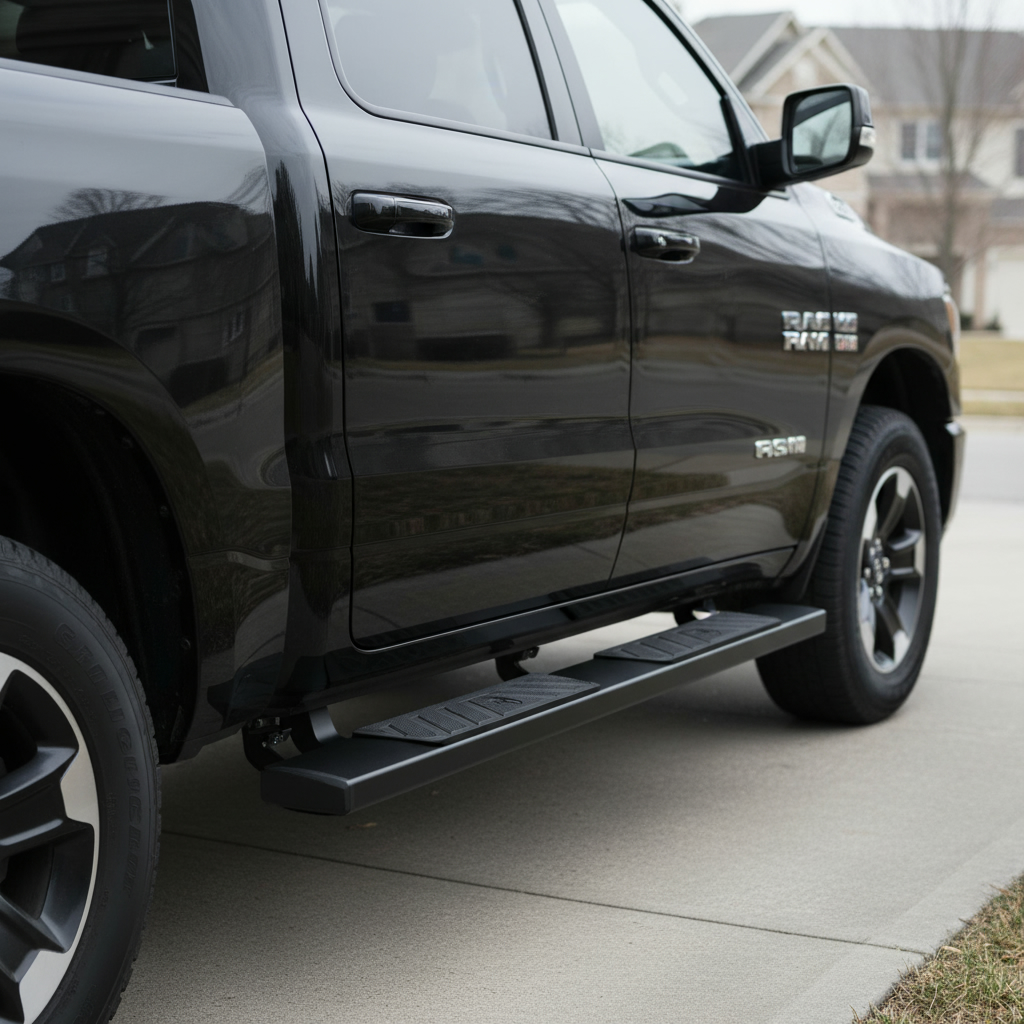
Interchangeability most often fails in two scenarios: swapping between different cab sizes, and swapping across a generation change. Even within the same nominal truck line, “close enough” measurements can still leave brackets fighting for alignment, or place the step too far inboard/outboard, changing ergonomics and increasing the chance of contact with the cab during flex.
Another subtle issue is corrosion and fastener condition on older trucks. A board may be theoretically compatible, yet practically difficult if factory threads are seized or if mounting points have been repaired. Guidance from vehicle manufacturers on proper jacking and support points can help avoid damaging the rocker area while inspecting fitment; see the National Highway Traffic Safety Administration’s owner resources at https://www.nhtsa.gov/ for vehicle documentation pathways.
How To Think About “Dodge COMNOVA Running Boards” In This Fitment Question
Searches like Dodge COMNOVA Running Boards or COMNOVA Running Boards Dodge usually reflect the same underlying concern: whether a listing’s stated year range and cab type truly match the truck in the driveway, rather than whether the brand name alone implies compatibility.
For broader context on vehicle modifications and safety-related considerations, the U.S. Federal Trade Commission’s consumer guidance hub at https://consumer.ftc.gov/ is a useful baseline for understanding labeling, advertising claims, and what “fit” statements should and should not imply.
Why “Will Dodge Running Boards Fit Any Dodge Pickup” Is Usually a Fitment Question
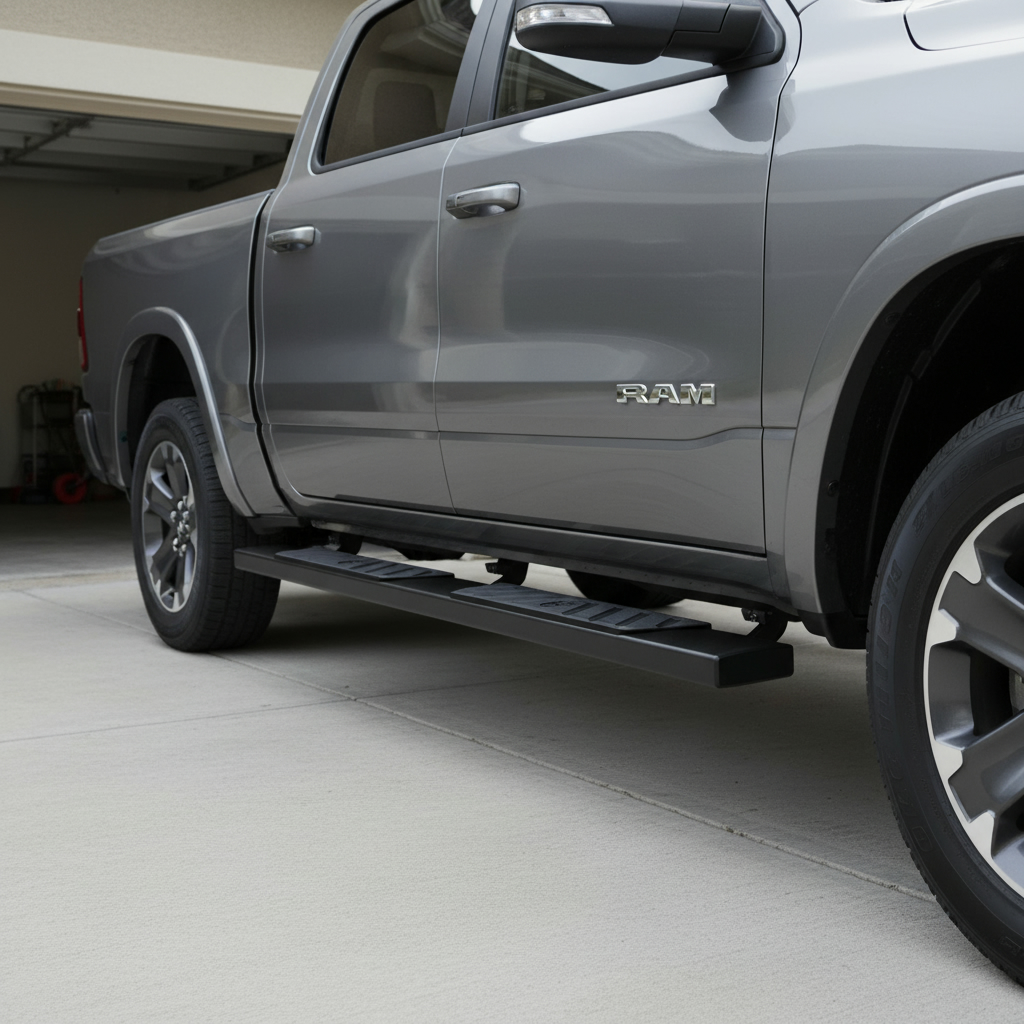
The question “will Dodge running boards fit any Dodge pickup” tends to collapse several fitment variables into a single yes-or-no. In practice, interchangeability is constrained by how the truck’s cab and frame were packaged in a specific generation, not by the badge on the grille. Even within a single nameplate, mounting points may shift with redesigns, and some trims introduce underbody equipment that competes for the same space a board or bracket would occupy.
Because of that, “will Dodge running boards fit any Dodge pickups” is better treated as a checklist of compatibility layers rather than a brand-wide assumption. A board that physically reaches the rocker area can still be wrong if the bracket geometry does not align with factory holes, or if it interferes with pinch welds, wiring, or factory steps.
Cab Configuration Is The First Gate, Not The Brand
When the goal is to understand whether Dodge running boards can move from one pickup to another, cab style is the fastest way to eliminate mismatches. The length of the rocker area and door spacing drives where supports need to land; boards are rarely “universal” across different cab layouts.
- Door count and spacing change the usable step length and where brackets must sit to avoid placing a support under a door seam.
- Rocker profile and flare can differ between trims; a board that tucks tightly on one truck may sit proud on another, affecting clearance and perceived stability.
- Cab-to-frame relationship can vary across heavy-duty and light-duty platforms, so the same-looking cab can still sit differently relative to the frame rails.
Model Year And Platform Changes Decide Most “Will It Fit” Outcomes
The most common failure mode behind “will Dodge running boards fit any Dodge pickup” is assuming a continuous platform across years. Redesigns often relocate body mounts, alter hole patterns, or revise corrosion protection measures that change how brackets are supposed to clamp or bolt. Even when factory holes exist in both trucks, their spacing may differ by small amounts that matter a lot in rigid steel bracketry.
Another subtlety: some years include different factory provisions. One truck may have threaded inserts; another expects a clip nut or a different fastener class. That is not just a convenience issue—mixing fastener styles can affect clamp load and long-term loosening behavior, especially in regions with road salt and freeze-thaw cycles.
Underbody Constraints That Make Fitment Look “Close” But Still Wrong
Fitment questions often get stuck at “the holes line up,” yet real-world clearance is where problems surface. Exhaust routing, transfer case skid plates, fuel and brake lines, and diesel emissions hardware can all change the underbody envelope. The board may mount, but end up too close to heat, too low for approach angles, or too tight to service points.
- Heat proximity near exhaust components can accelerate coating wear and increase the chance of rust initiation at edges and fasteners.
- Service access matters: a board that blocks jack points or routine inspection areas can become an ongoing nuisance.
- Ground clearance and breakover trade-offs show up most on uneven terrain, where a slightly lower step becomes a contact point.
How To Verify Interchangeability Without Guessing
For readers circling the same question—will Dodge running boards fit any Dodge pickup—the most reliable approach is to verify mounting architecture, not marketing language. Dimensional checks are useful, but attachment method is decisive: bolt-on to factory holes, clamp to pinch weld, or hybrid mounting each implies different tolerances and risks.
Where official guidance exists, it is usually framed as vehicle modification and accessory fitment rather than brand-specific interchangeability. The National Highway Traffic Safety Administration (NHTSA) emphasizes that modifications can affect safety if they interfere with vehicle components or operation, a relevant lens for steps that sit near side airbags wiring routes or jacking points (https://www.nhtsa.gov/vehicle-safety).
As a single illustration of how narrow these fitment windows can be, a listing may claim compatibility across multiple Ram years and cab types, but that statement still depends on the exact cab configuration and platform details.
Will Dodge Running Boards Fit Any Dodge Pickup: The Real Answer Is In The Details
The question “will Dodge running boards fit any Dodge pickup” tends to come from a reasonable assumption: if the badge is the same, the mounting points should be, too. In practice, interchangeability is limited. Fitment is governed less by brand and more by platform generation, cab configuration, and what the frame and body provide as factory attachment locations.
Even within what people casually call a “Dodge pickup,” there are distinct eras and naming conventions, plus model lines that share a look but not necessarily the same underbody layout. That is why the most accurate framing of “will Dodge running boards fit any Dodge pickups” is: sometimes within a narrow set of matching conditions, rarely across them.
Three constraints explain most mismatches:
- Attachment geometry: Bracket spacing and hole locations (or threaded inserts) are fixed by the vehicle’s structure; a few millimeters off can prevent proper alignment.
- Cab length reality: A longer cab typically needs a longer step area and different support placement; shorter cabs can leave extra length hanging unsupported.
- Clearance envelope: Body cladding, rocker contours, and the distance from the pinch seam to the frame can change, affecting whether the step sits level and clears doors.
This is also why search results can look contradictory: two people may both be “right,” but they are talking about different cabs, different generations, or different mounting strategies.
When “Fits” In Search Results Does Not Mean Fits On The Truck
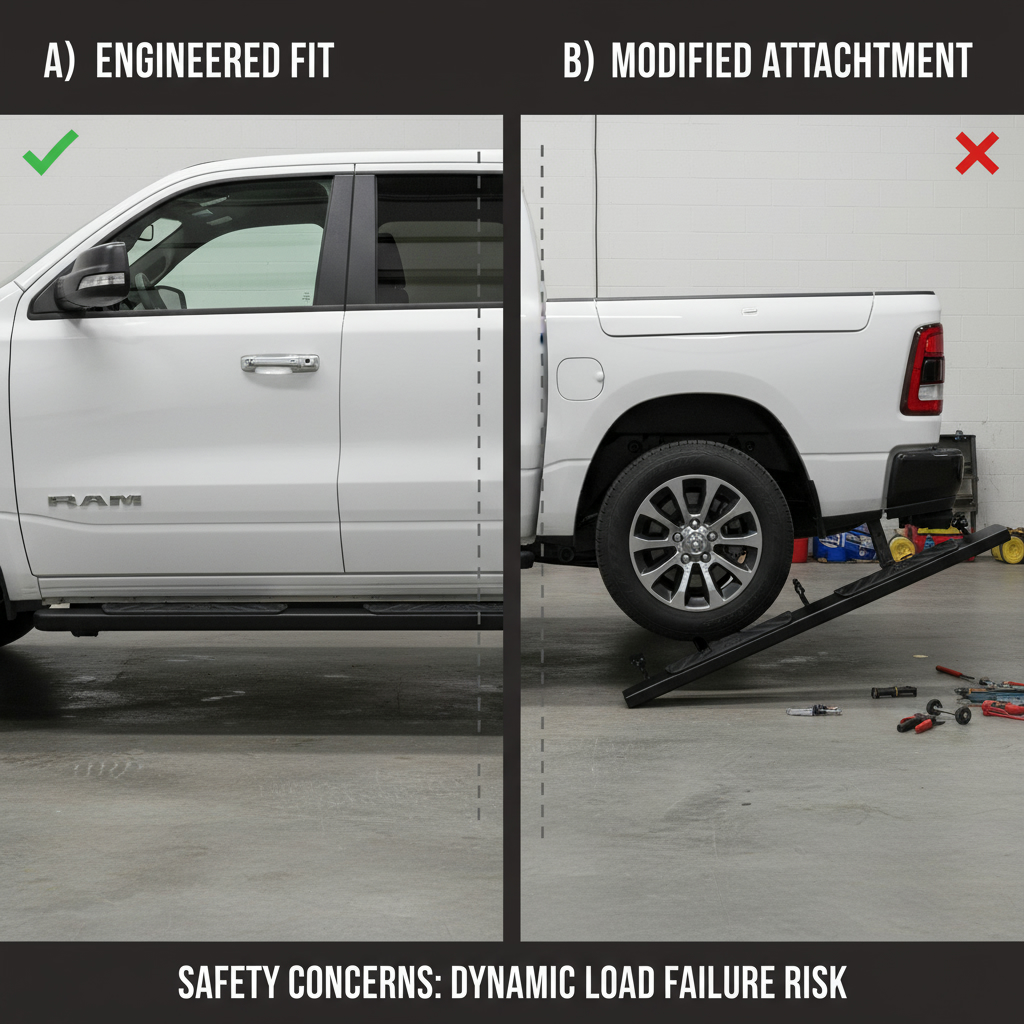
Fitment language online often collapses multiple ideas into one word. “Fits” may mean the bolt pattern lines up, or it may mean “can be made to attach.” Those are not equivalent in safety terms. A step assembly is a load-bearing structure; it is expected to handle repeated dynamic loads, not just hang in place.
A more careful interpretation is to separate:
- Direct Fit: aligns with existing mounting points without altering the vehicle structure.
- Conditional Fit: aligns only with specific trims, years, or cab types that share the same underbody provisions.
- Adapted Fit: requires drilling, slotting, or non-standard hardware choices; this changes load paths and corrosion protection considerations.
For readers trying to resolve “will Dodge running boards fit any Dodge pickup,” the key is to treat “adapted fit” as a different category entirely, not a simple extension of compatibility.
Compatibility Checks That Reduce Confusion Without Turning Into a Shopping Exercise
Compatibility can be reasoned about without relying on listing claims. The most reliable checks are structural and terminology-based, not marketing-based:
- Confirm the exact cab configuration label used by the manufacturer for that model year; casual terms like “four-door” can be ambiguous.
- Look for factory-provided mounting points or threaded inserts along the rocker/frame area; their count and spacing matter more than the vehicle name.
- Distinguish “classic” carryover models from redesigned generations; carryovers can share names while differing in underbody details.
For general background on vehicle modifications and the importance of following manufacturer information, the National Highway Traffic Safety Administration provides consumer-facing guidance on vehicle equipment and safety considerations at https://www.nhtsa.gov.
FAQ: Interpreting “Will Dodge Running Boards Fit Any Dodge Pickup” In Real Searches
Why Do Forums Disagree on Whether Running Boards Interchange?
People often describe the vehicle loosely, or they assume two trims share the same underbody. Small platform changes, cab differences, and mid-cycle updates can make both experiences true in their specific context.
Is “Will Dodge Running Boards Fit Any Dodge Pickup” Basically a Question About Years or About Cab Types?
It is usually both, but cab type is the fastest source of mismatch because length and bracket placement are tied together. Model year matters because redesigns can move or change mounting provisions even when the badge stays familiar.
If a Listing Says It Fits a Range of Years, What Should Be Verified First?
Verify that the vehicle has the same style of mounting points the listing assumes (threaded inserts versus clamp-style versus other approaches). If that underlying assumption is wrong, the quoted year range is not meaningful for that specific truck.
Do “Dodge Running Boards” and “Ram” Terminology Changes Affect Fitment, or Just Naming?
The naming change itself does not determine fitment, but it can hide platform differences when people talk imprecisely. The practical risk is mixing up generations and cab labels under a single casual term like “Dodge pickup.”