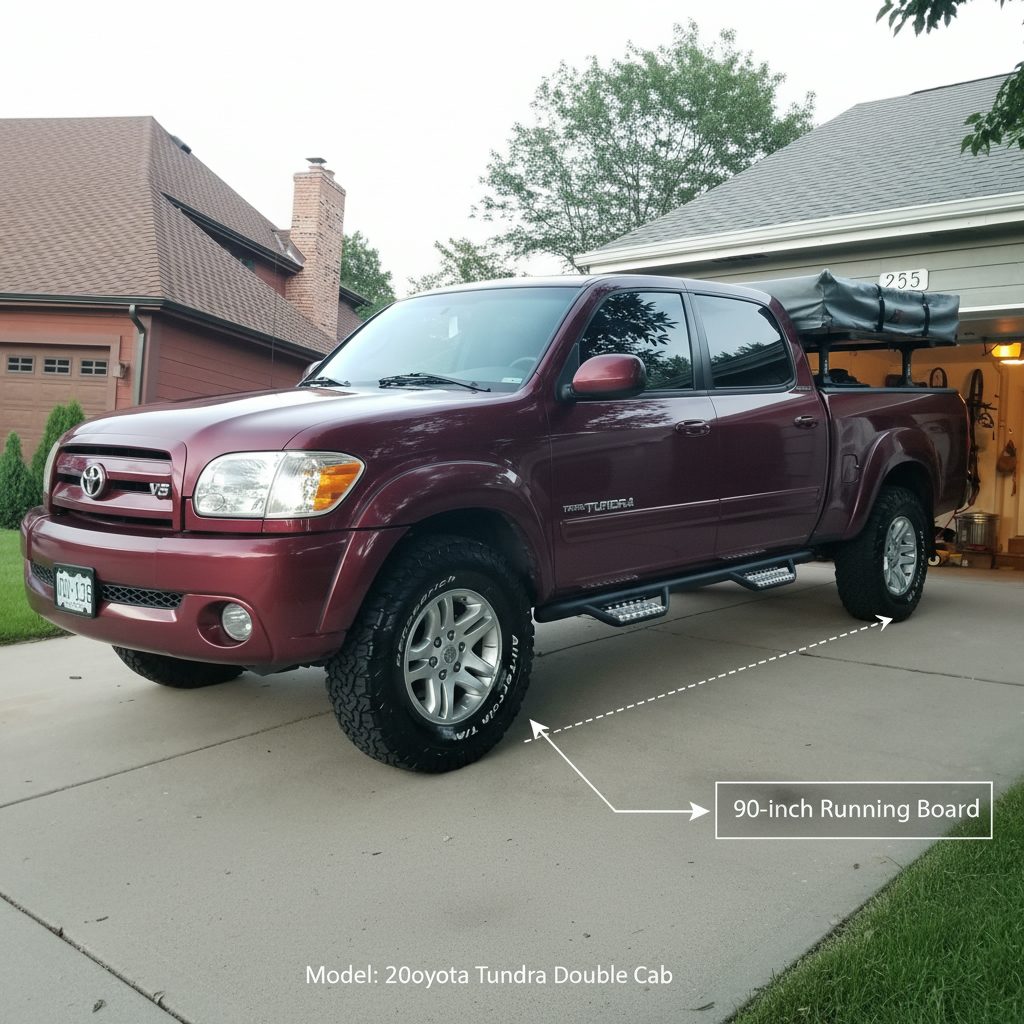
The question sounds simple. It rarely is. “Will 4Runner running boards fit Tacoma” usually comes up when two TOYOTA platforms look close enough that the hardware seems interchangeable, but the attachment points live in a world of millimeters, brackets, and model-year changes.
Running boards are not just a step surface. They are a body-mounted (sometimes frame-adjacent) assembly that has to match the vehicle’s underside geometry, door opening sweep, and corrosion protection strategy. When any of those don’t line up, a board can sit crooked, contact the rocker area, or leave fasteners under tension—none of which is desirable on a daily driver or a vehicle that sees winter road salt.
Quick Orientation on What “Fit” Means Here
-
In practical terms, fitment means the board’s brackets align with factory mounting points without forcing, drilling, or stressing threads.
-
People typically encounter this question in forum threads after spotting similar-looking hardware across TOYOTA models or across generations.
-
A safe assumption: “TOYOTA” does not guarantee interchangeability. A misleading one: “same wheelbase” or “similar body shape” equals bolt-on compatibility.
Why “Will Tacoma Running Boards Fit 4Runner” Is a Common Compatibility Trap
From the outside, Tacoma and 4Runner can appear to share proportions and design language. Underneath, they are built around different body structures and packaging constraints. The Tacoma is a pickup with a cab-and-bed layout; the 4Runner is an SUV body. That difference changes how rocker areas are reinforced, where captive nuts are placed, and what clearance exists near pinch seams and body mounts.
Even when both vehicles use body-on-frame construction, the running board interface is usually defined by the body’s mounting provisions, not by a generic “TOYOTA frame standard.” A board that “almost fits” often fails at the bracket geometry: the standoff distance is off, or the bracket lands where there is no threaded insert.
What Actually Determines Whether 4Runner Running Boards Fit Tacoma
Fitment is governed by a few hard constraints. They are boring. They are also decisive.
-
Mounting Point Pattern: Number of mounts, spacing between them, and whether the vehicle uses welded studs, threaded inserts, or through-bolts.
-
Bracket Offset and Angle: How far the board must sit from the rocker area to clear doors and trim, and how the bracket compensates for underbody shape.
-
Cab/Body Length: A Tacoma’s cab configuration changes usable board length and bracket positions; SUVs typically follow a different length logic.
-
Underbody Interference: Fuel and brake line routing, wiring looms, and mud flaps can conflict with a bracket that was never designed for that chassis.
-
Model-Year Engineering Changes: Small revisions can move a mounting point or change thread pitch, turning “same generation” into “no longer bolt-on.”
Generation and Year Questions: Why “5th Gen vs 4th Gen” Comes Up
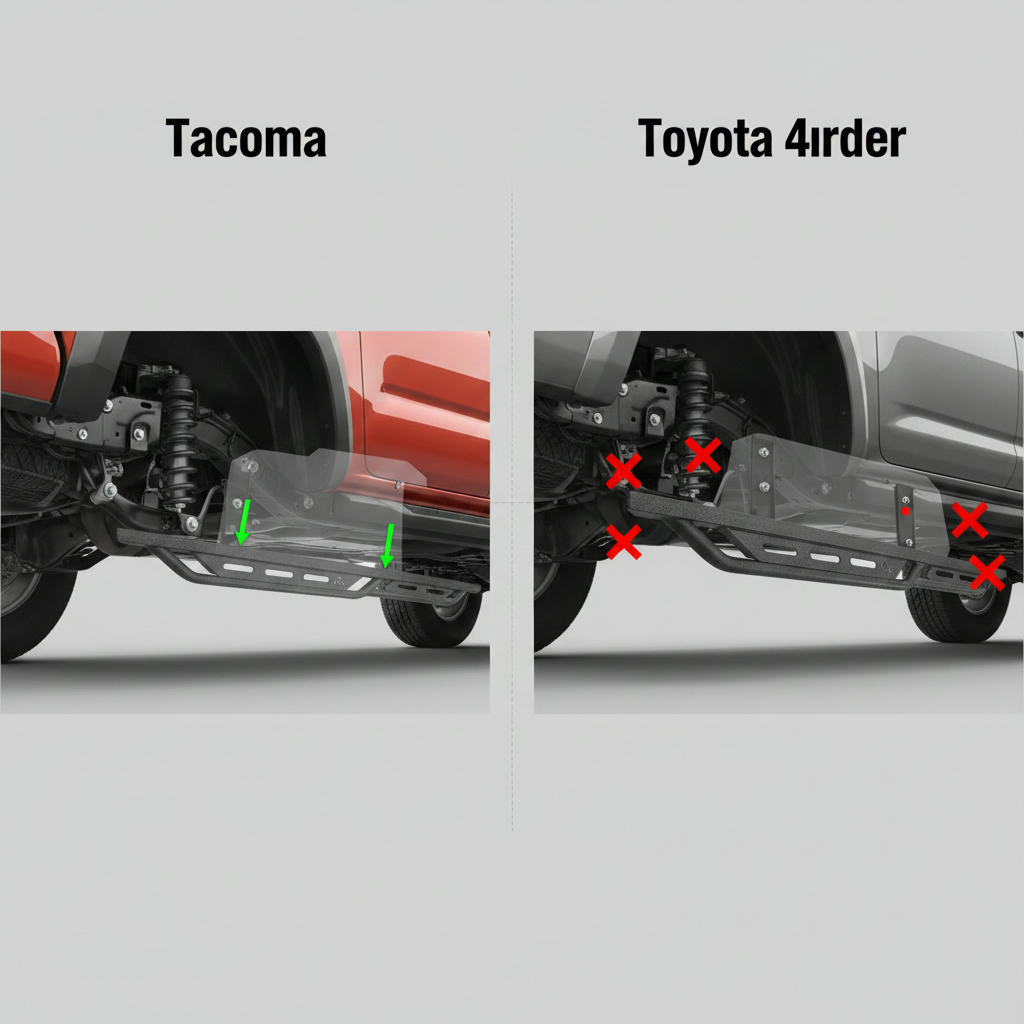
Threads like “do 5th gen 4Runner running boards fit 4th gen” and “will 5th gen 4Runner running boards fit 3rd gen” reflect a real pattern: people assume a generation label implies shared underbody hard points. In practice, each generation can relocate brackets to accommodate body redesigns, side airbag sensor placement, different rocker molding shapes, or revised corrosion countermeasures.
The same logic applies within Tacoma discussions such as “will 2017 Tacoma running boards fit 2009 Tacoma.” The cab architecture, mount style, and even fastener standards can change across those years. Visual similarity is not evidence.
For a grounded way to think about vehicle structure and why mounting provisions change across models and years, the National Highway Traffic Safety Administration’s vehicle research and safety materials are a useful reference point: https://www.nhtsa.gov/
Why “Will 4Runner Running Boards Fit Tacoma” Rarely Has a Clean Yes-or-No
The question “will 4Runner running boards fit Tacoma” sounds like a simple swap, but fitment lives in the gaps between platforms and production years. Even when two TOYOTA vehicles feel closely related, the mounting geometry is not governed by “SUV versus pickup” as a label; it is governed by where the body has reinforced attachment points, how far apart they are, and whether the board’s brackets were designed around those points. That is why “do 4Runner running boards fit Tacoma” often turns into a discussion about bracket patterns rather than the board itself.
A common misconception is that length is the primary issue. Length matters, but it is usually the secondary constraint. The first failure point is typically the interface: bolt-hole spacing, bracket offset, and whether the body has threaded inserts or requires clip-nuts. If the underlying attachment strategy differs, a board can look “close” and still be wrong in the only way that counts: it cannot be fastened safely without improvisation.
Mounting Architecture: The Real Compatibility Gate
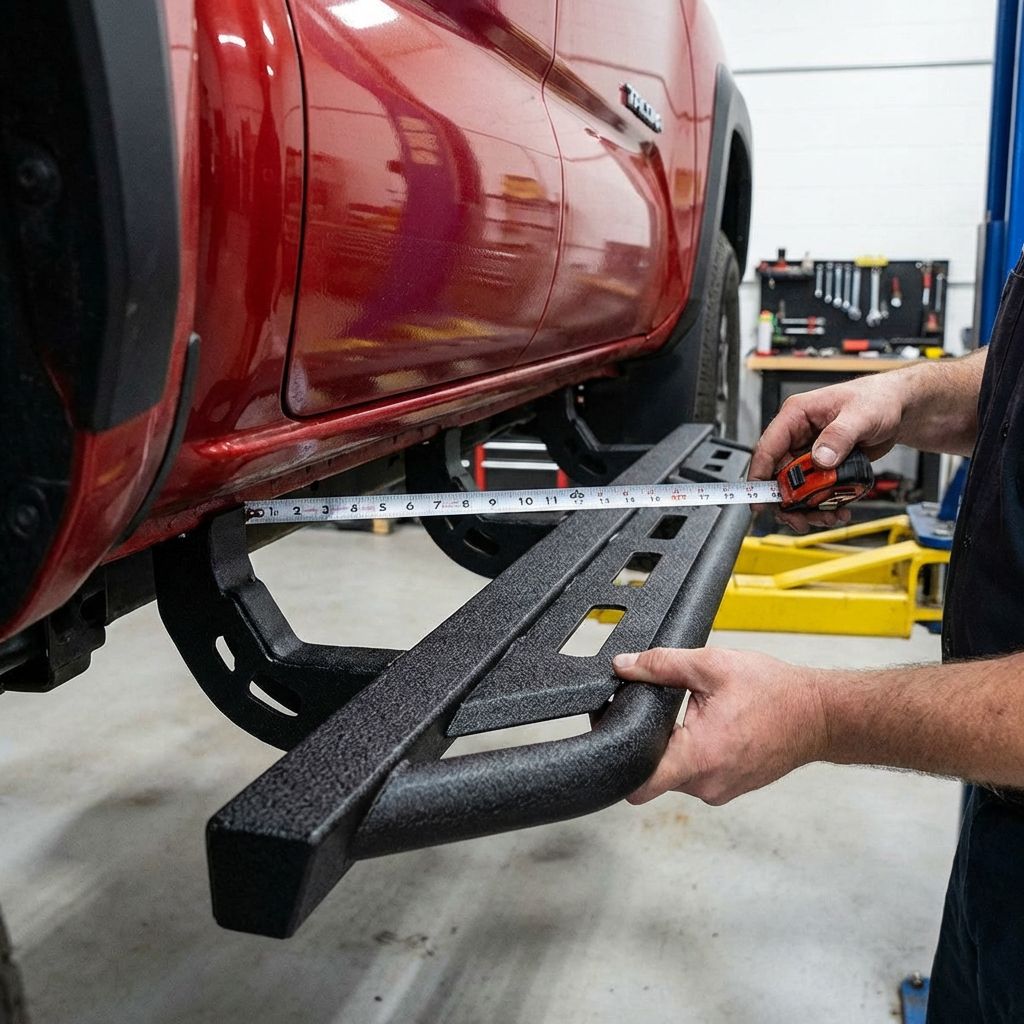
Most running-board systems assume a specific load path: step load into the board, into brackets, into reinforced points on the rocker or frame-adjacent structure. When people ask “will Tacoma running boards fit 4Runner,” the hidden question is whether those reinforced points exist in the same places and are meant to take the same kind of load.
- Attachment point location: Vehicles can have similar exterior proportions yet place threaded bosses differently because of floorpan and rocker design.
- Bracket offset and drop: A bracket designed for one rocker profile may push the board too far inboard or outboard on another, changing usability and sometimes causing contact with body cladding.
- Number of supports: Some setups rely on two or three brackets per side. If the recipient vehicle’s structure does not match those positions, skipping a bracket is not an equivalent substitute.
- Hardware strategy: Factory-style threaded inserts are not interchangeable with clip-nut or through-bolt assumptions; mismatching them encourages overtightening, stripped threads, or loose joints over time.
Year and Generation Nuance: Why “5th Gen” and “4th Gen” Questions Persist
Generation shorthand is useful, but it can hide mid-cycle changes. Questions like “do 5th gen 4Runner running boards fit 4th gen” persist because the exterior silhouette suggests continuity, while the underbody attachment points may not. Even within a single generation, trim-level cladding and rocker molding can change the required bracket height or the board’s inboard clearance.
Similar logic drives “will 5th gen 4Runner running boards fit 3rd gen” discussions: the further apart the platforms are in time, the more likely the mounting scheme and body reinforcement strategy have been redesigned. The visible shape can be misleading; the invisible attachment plan is what dictates interchangeability.
Fitment Checks That Matter More Than Forum Consensus
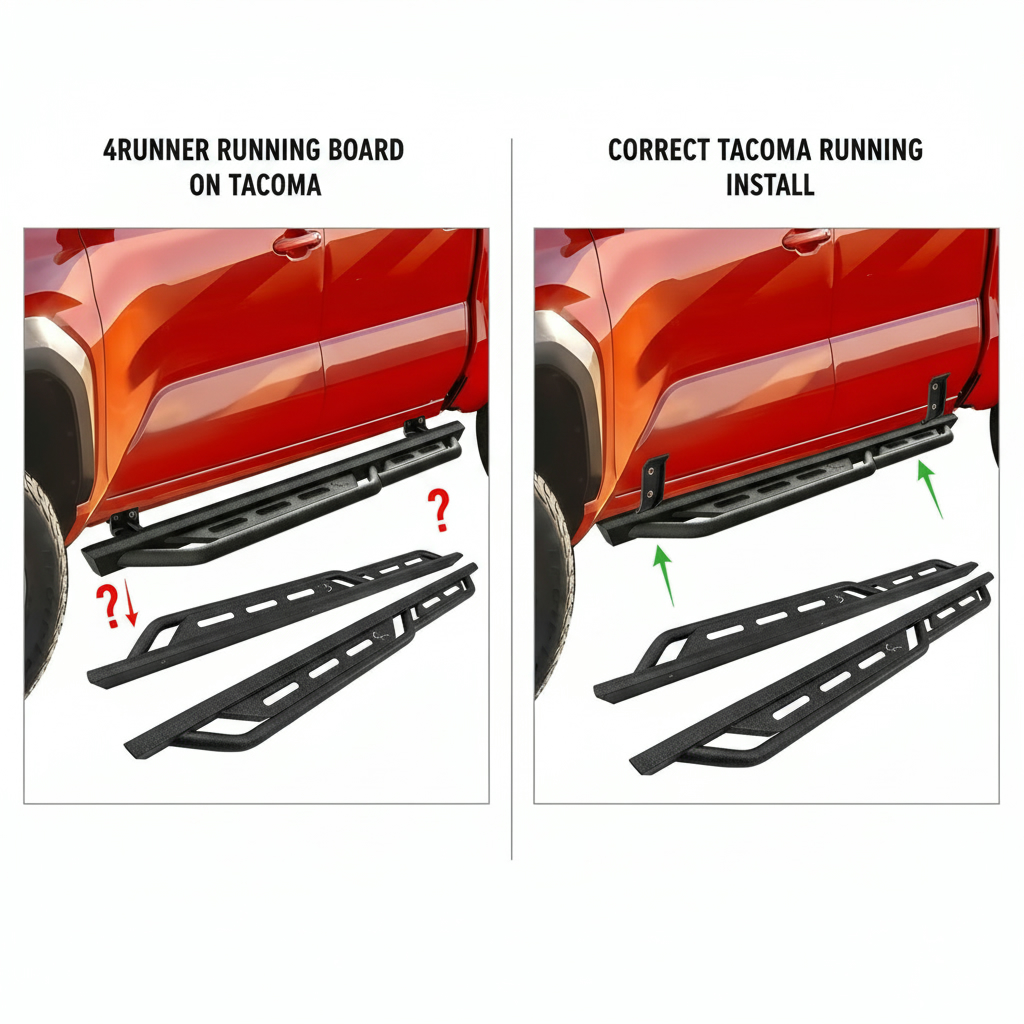
Community reports are valuable, but they often blend “bolted on” with “bolted on correctly.” Before treating “will 4Runner running boards fit Tacoma” as answered, these checks usually separate true fitment from “custom work made it happen”:
- Confirm the exact mounting points on the vehicle: presence, thread type, and spacing; a missing boss is not a minor detail.
- Verify bracket-to-body alignment without forcing: if one bolt starts only when another is loose, the bracket geometry may be wrong and can preload the joint.
- Account for rocker cladding and mudflap interfaces: interference can create rubbing, trapped debris, or an unusable step position.
- Consider door swing and step placement: a board that sits too far out can be awkward; too far in can be functionally pointless, even if it technically mounts.
For general background on vehicle modifications and the importance of safe installation practices, the National Highway Traffic Safety Administration’s consumer resources provide a useful safety baseline: https://www.nhtsa.gov/
When “2017 Tacoma Running Boards Fit 2009 Tacoma” Becomes a Different Question
Within the same nameplate, swapping across model years is still not guaranteed. “Will 2017 Tacoma running boards fit 2009 Tacoma” is effectively a question about whether the cab’s rocker structure and mounting provisions stayed consistent across redesigns. A generation change can relocate attachment points, alter rocker profiles, or introduce different cladding thickness. Even if an adapter bracket exists in the aftermarket, that is no longer “fit” in the strict sense; it is a conversion that introduces new variables (fastener engagement, corrosion pathways, and long-term loosening behavior).
In practice, the most reliable compatibility claims come from dimensional confirmation and official service documentation rather than visual similarity. TOYOTA’s technical information ecosystem is structured to map parts to platforms and production ranges, which is why fitment questions often end by cross-checking those sources rather than debating appearances: https://www.toyota-tech.eu/
When “Will 4Runner Running Boards Fit Tacoma” Has a Clear Answer and When It Doesn’t
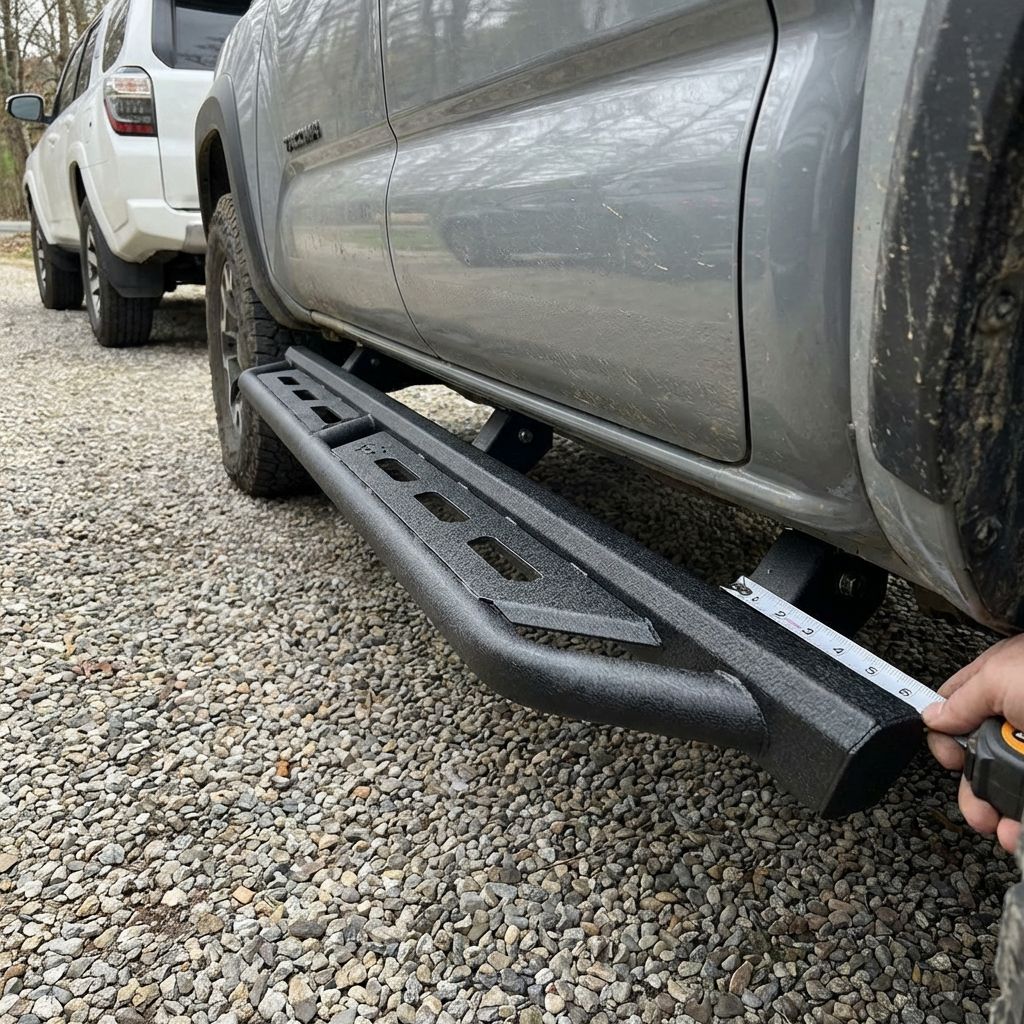
The question “will 4Runner running boards fit Tacoma” sounds like it should resolve to a simple yes or no. In practice, it only becomes a clean answer when the underlying mounting architecture is known: how the vehicle’s body is drilled or welded for attachment points, how brackets index to the rocker area, and how much tolerance exists before a board sits twisted, contacts trim, or leaves unsafe gaps.
That is why forum threads often look contradictory. Two people can both be “right” because they are talking about different generations, different cab/body configurations, or different attachment schemes. Even within a single generation, small running changes can alter hole patterns or the shape of the pinch weld area, which is enough to turn a near-fit into a no-fit without modification.
As a decision filter, the question is less about the board itself and more about the interface. The fitment risk rises fast when any of these are unknown:
- The exact generation and body configuration on both sides of the swap, because attachment points are tied to platform-specific underbody geometry.
- Whether the design expects factory threaded inserts versus clamp-style interfaces, since those are not interchangeable without additional hardware or drilling.
- Clearance around rocker trim and lower door edges, where a few millimeters can change door swing clearance, noise, or water trapping.
Related searches like “do 4Runner running boards fit Tacoma” and “will Tacoma running boards fit 4Runner” are essentially the same question asked in reverse. The same logic applies: matching “length” is not enough; bracket spacing, load paths, and corrosion protection at the attachment points matter more than the visible profile.
Generation and Platform Mixing: Why “Close Enough” Can Become a Safety Issue
Cross-generation questions such as “do 5th gen 4Runner running boards fit 4th gen” or “will 5th gen 4Runner running boards fit 3rd gen” surface because the vehicles can look similar in side profile. The underbody, however, is where compatibility is decided. If the brackets do not land on reinforced areas intended to carry step loads, the stress can concentrate in thin sheet metal, which can loosen fast under repeated use.
There is also a corrosion and durability angle. When a part is forced to fit—through slotting holes, mixing fasteners, or clamping where a threaded insert was intended—the protective coatings and sealants around the attachment points can be compromised. Over time, that can matter more than the initial “it bolts up.” General guidance on corrosion mechanisms and prevention is covered well by the U.S. National Park Service preservation resources, which are broadly applicable to coated metals and fastener interfaces: https://www.nps.gov/subjects/preservation.htm.
What Realistic Expectations Look Like for Fitment Questions
Fitment discussions tend to over-weight a single success story. A more realistic expectation is that “will 4Runner running boards fit Tacoma” is answerable only at the level of specific vehicle details and a verified attachment method. Without that, the most honest outcome is probabilistic: it may align, it may partially align, or it may require changes that effectively create a custom installation.
One misconception is that “OEM” automatically implies cross-compatibility. OEM usually means “designed for a particular configuration,” not “universal across related vehicles.” Another misconception is that if holes line up, the load path is correct. Proper load transfer depends on where the structure is reinforced, not just where a bolt can be placed.
FAQ: Clearing Up Common Fitment Confusion
Why Does the Same Fitment Question Get Different Answers in Different Threads?
People often describe the visible outcome (“it fits”) without matching the underlying vehicle configuration. Small platform differences, running changes, and missing details about attachment points can produce answers that sound contradictory but aren’t.
What Does “Will 4Runner Running Boards Fit Tacoma” Usually Mean in Practice?
It usually means “will the attachment points and bracket geometry match without modification.” The visible length is rarely the limiting factor; the underbody interface is.
If Something Bolts On, Is It Automatically Safe to Use as a Step?
Not necessarily. A bolt-on result can still place loads into weaker sheet metal or misaligned brackets, which can loosen over time. Load-bearing safety depends on reinforced mounting locations and correct fastener engagement.
Why Do Generation-to-Generation Swaps Create More Uncertainty Than Expected?
Generations can share styling cues while changing structural hard points underneath. Even minor changes in bracket spacing or rocker geometry can shift a setup from aligned to stressed, especially under repeated stepping loads.